Revolutionary Catalyst Technology Targets Ethane and CO₂ for Cleaner Chemistry
2025-04-21
Author: Mei
Unlocking the Future of Chemical Production
Ethylene is a superstar in the world of light olefins, serving as a key ingredient in creating a wide array of valuable chemical products. However, the traditional methods for industrial ethylene production—relying heavily on steam cracking of ethane and naphtha—are plagued by serious downsides: massive energy consumption, hefty carbon emissions, and troublesome coke buildup.
A Greener Solution: CO₂-Assisted Ethane Processing
Enter the game-changing CO₂-assisted oxidative dehydrogenation of ethane (CO₂-ODHE), an eco-friendly approach that leverages ethane resources along with the notorious greenhouse gas, CO₂. This innovative technology not only holds promise for reducing carbon footprints but also plays a crucial role in the strides toward carbon neutrality and sustainable chemical production.
Overcoming Catalyst Limitations
Despite its promise, existing catalyst systems face significant hurdles, primarily the tricky balancing act between activity and selectivity, alongside stability issues. The quest for catalysts that can effectively cleave C–H bonds in ethane while simultaneously activating CO₂ has long posed a complex challenge in the landscape of CO₂-ODHE.
Introducing the ZnxZrO Catalyst: A Breakthrough in Chemical Engineering
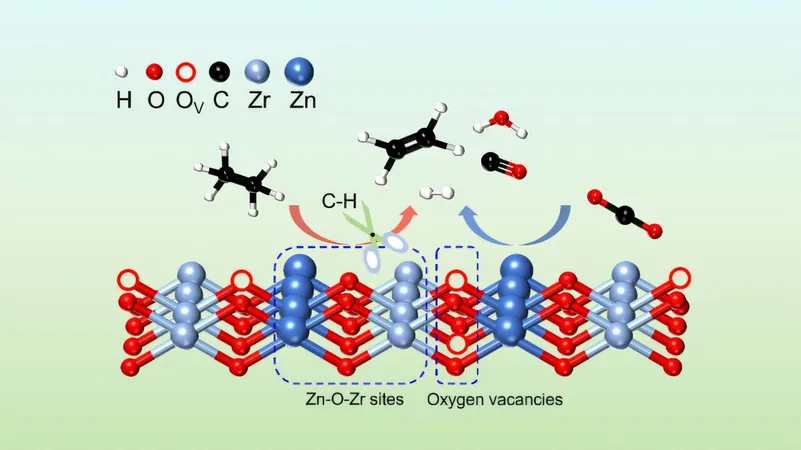
A groundbreaking study has unveiled the ZnxZrO bifunctional catalyst, which exhibits remarkable synergistic effects in the simultaneous activation of C–H and C=O bonds. Advanced characterization techniques were employed to explore the surface chemistry of ZnxZrO during the CO₂-ODHE process, revealing unique functionalities of its active sites.
The Mechanism Behind the Magic
Published in the Chinese Journal of Catalysis, the findings show that the Zn-O-Zr sites are adept at selectively cleaving ethane's C–H bonds, while the presence of oxygen vacancies plays a vital role in activating CO₂'s C=O bonds. This paves the way for a synergistic conversion process involving both ethane and CO₂, with in situ FTIR techniques detailing the intricate mechanisms at play, including ethane dehydrogenation and the reverse water-gas shift (RWGS).

 Brasil (PT)
 Canada (EN)
 Chile (ES)
 Česko (CS)
 대한민국 (KO)
 España (ES)
 France (FR)
 Hong Kong (EN)
 Italia (IT)
 日本 (JA)
 Magyarország (HU)
 Norge (NO)
 Polska (PL)
 Schweiz (DE)
 Singapore (EN)
 Sverige (SV)
 Suomi (FI)
 Türkiye (TR)
 الإمارات العربية المتحدة (AR)