Revolutionary Compact Device Offers Ultra-Narrow Spectral Linewidth for Free Electron Radiation
2025-04-21
Author: Daniel
Unleashing the Power of Superradiant Smith-Purcell Radiation
Imagine harnessing free electrons to produce incredibly precise radiation that could revolutionize imaging, sensing, and communication technologies. This dream is becoming a reality with the breakthrough development of a compact Superradiant Smith-Purcell Radiation (S-SPR) device, capable of achieving ultra-narrow spectral linewidths.
The Challenge with Traditional Setups
In traditional free electron accelerators, various factors have hampered the efficiency and stability of radiation linewidth, including electron kinetic energy fluctuations, the Coulomb effect, and a limited number of electron bunches. Moreover, the large physical size of existing equipment has significantly restricted its practical applications.
A Breakthrough from Tsinghua University
A team of innovative scientists, led by Professor Fang Liu and Yidong Huang from Tsinghua University, has made a giant leap forward. Their latest research, published in eLight, presents the first-ever compact S-SPR device that features an ultra-narrow and continuously tunable spectral linewidth.
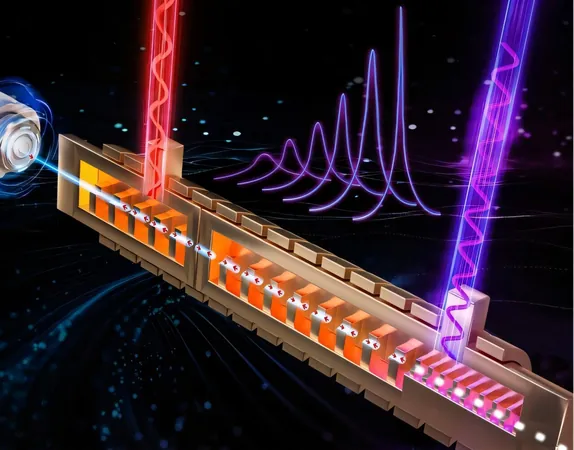
Introducing the novel Pump-Induced Stimulated S-SPR (PIS-SPR), the researchers successfully achieved a frequency of approximately 0.3 THz, with the radiation linewidth adjustable between an astonishing 900 kHz and 0.3 kHz. This groundbreaking device, weighing only 1.68 kg and fitting comfortably in one hand, measures just 22 cm x 7 cm x 6.5 cm.
Innovative Design and Functionality
The compact PIS-SPR device comprises three essential sections: electron pre-bunching, electron compression, and harmonic emission. Its operational magic lies in a low-frequency, low-power THz pump wave that excites localized electromagnetic modes on the grating, effectively pre-bunching the electron beam. This allows for the generation of S-SPR that aligns with the pump wave frequency.
Overcoming Key Limitations
This innovative approach successfully tackles the three major factors that previously deteriorated radiation linewidth: the instability of electron kinetic energy, the Coulomb effect, and the finite number of electron bunches. By adjusting the number of electron bunches, from around 105 to 109, researchers achieved an impressive reduction in linewidth of 2 to 6 orders of magnitude compared to traditional setups.
Beyond PIS-SPR: New Possibilities
Interestingly, the device can also function without a pump wave, operating in a backward waveguide mode (BWM). While broader linewidths were observed in this mode, the evolution from BWM to PIS-SPR was experimentally tracked by gradually increasing pump wave power. The power of the pump wave demonstrated a significant influence on the electron bunching process.
A Bright Future for S-SPR Applications
This groundbreaking work opens up tremendous possibilities, setting the stage for compact, narrow linewidth radiation sources across various frequency ranges. The implications extend beyond just radiation, promising advancements in generating frequency-locked and tunable free electron bunches for applications in micro- and nanostructures.
Moreover, the scientists suggest that their enhanced light field method could eventually lead to on-chip electron acceleration, achieving even higher electron gradients. The future of photonics looks brighter than ever!


 Brasil (PT)
 Canada (EN)
 Chile (ES)
 Česko (CS)
 대한민국 (KO)
 España (ES)
 France (FR)
 Hong Kong (EN)
 Italia (IT)
 日本 (JA)
 Magyarország (HU)
 Norge (NO)
 Polska (PL)
 Schweiz (DE)
 Singapore (EN)
 Sverige (SV)
 Suomi (FI)
 Türkiye (TR)
 الإمارات العربية المتحدة (AR)