Revolutionary Computational Method Enhances Genomic Prediction in Crop Breeding!
2025-04-24
Author: Arjun
Unlocking the Secrets of Crop Development
In a groundbreaking advancement for agricultural science, researchers at the IPK Leibniz Institute and the Max Planck Institute of Molecular Plant Physiology have developed a cutting-edge computational method aimed at dramatically improving the accuracy of genomic predictions for key agricultural traits. Published in the esteemed journal Nature Plants, this research aims to overcome existing challenges in understanding how multiple traits evolve throughout a plant’s life cycle.
The Complex Phenome Puzzle
Every plant expresses a range of traits that are influenced by genetic makeup, environmental factors, and their intricate interactions. This complex interplay creates a 'phenome'—the full spectrum of traits exhibited by a plant at various stages of development. To effectively predict these traits, insights into how they change over time are crucial. However, the existing genomic prediction methods have struggled to address the dynamic nature of these traits.
Introducing dynamicGP: A Game Changer for Predictive Agriculture
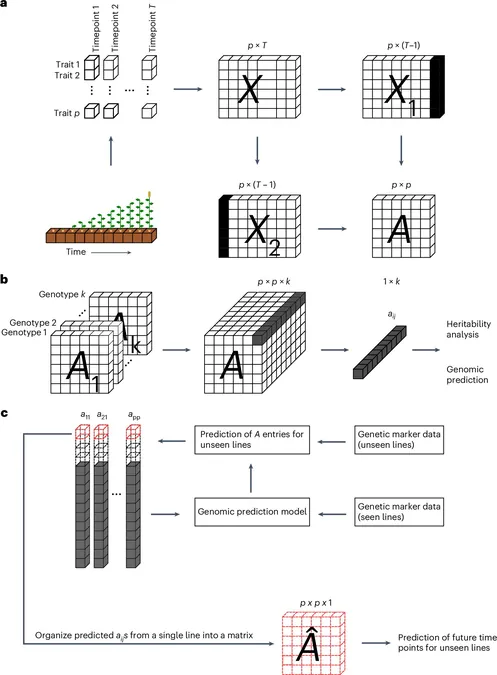
Enter dynamicGP, a revolutionary computational approach that allows researchers to accurately forecast trait dynamics throughout a plant's growth stages. By harnessing data from high-throughput phenotyping (HTP) platforms, dynamicGP offers a sophisticated way to analyze and predict the traits of different plant genotypes over time.
David Hobby, a leading researcher in the study, highlights the importance of dynamicGP: "By merging genomic prediction with dynamic mode decomposition (DMD), we created a robust tool for understanding genotype-specific traits in crops, paving the way for significant advancements in agricultural productivity."
Elevating Predictive Accuracy for Crop Breeding
In their research, scientists employed data from a maize multi-parent advanced generation inter-cross population alongside an Arabidopsis thaliana diversity panel. The results were astonishing: dynamicGP outperformed traditional genomic prediction methods, especially for traits that exhibit stable heritability over time.
As noted by Dr. Marc Heuermann from IPK, "Our findings suggest that traits with consistent heritability can be predicted with remarkable accuracy, revealing crucial insights into how we can improve trait predictability throughout a crop’s life cycle."
A Bright Future for Precision Agriculture
The implications of dynamicGP are profound, offering a new lens through which to explore the relationship between genotype and phenotype during crop development. Looking ahead, future adaptations of this model will further incorporate environmental influences, enhancing its applicability in real-world situations.
The potential to breed crop varieties specifically tailored to local conditions and advances in precision agriculture could revolutionize food production and sustainability worldwide. This breakthrough is set to make waves in the fields of agriculture and biosciences, ushering in a new era of crop improvement!


 Brasil (PT)
 Canada (EN)
 Chile (ES)
 Česko (CS)
 대한민국 (KO)
 España (ES)
 France (FR)
 Hong Kong (EN)
 Italia (IT)
 日本 (JA)
 Magyarország (HU)
 Norge (NO)
 Polska (PL)
 Schweiz (DE)
 Singapore (EN)
 Sverige (SV)
 Suomi (FI)
 Türkiye (TR)
 الإمارات العربية المتحدة (AR)