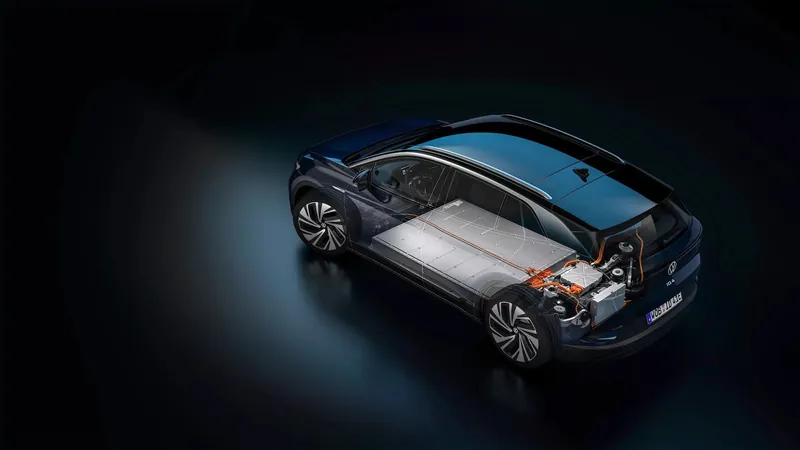
Revolutionary Cooling Tech Set to Transform Electric Vehicles
2025-04-20
Author: Wei Ling
Game-Changing Heat Management for Electric Vehicles!
Excess heat poses a significant threat to the sensitive electronics in electric vehicles (EVs), particularly their batteries and critical components. Currently, modern EVs are loaded with radiators and complex plumbing systems designed to manage this excess heat effectively, while also maintaining interior warmth during cold weather. But groundbreaking research from the University of Virginia has unveiled a revolutionary technique for managing heat that may mimic the way light travels!
Harnessing the Power of Hexagonal Boron Nitride!
Yes, you read that right! Engineers have discovered a method to transfer heat as if it were a beam of light, thanks to an extraordinary substance known as hexagonal boron nitride (hBN) crystals. This innovative material is key to overcoming traditional thermal management challenges faced by electronic devices.
The Future of Electronics is Here!
As detailed in the prestigious journal *Nature Materials*, hBN's unique properties enable thermal energy to travel in a directed beam rather than dissipating in smaller, less efficient waves. This innovation holds the potential to not only revolutionize smartphones, supercomputers, and medical devices, but particularly to enhance electric vehicles.
Unlocking Performance Potential!
Imagine future EVs that boast longer ranges, improved battery longevity, and faster charging capabilities. Generally, electronic components tend to overheat during intense use—whether that’s your computer while gaming, your smartphone during a video call, or your EV when utilizing DC fast charging. Such heat buildup can lead to performance dips and long-term damage.
Traditional Cooling vs. Next-Level Technology!
In conventional cooling systems, heat is managed through fans, heat sinks, and liquid cooling—methods that can be sluggish in their response. However, the innovative approach using hyperbolic phonon-polaritons (HPhPs) changes the game entirely. In simpler terms, while traditional systems spread heat out like ripples in a pond with diminishing energy, this new technique confines heat into tightly packed waves, allowing for efficient and rapid thermal transport over long distances.
Speedy Heat Transfer Like Never Before!
In their study, scientists placed a small gold pad on top of hBN and heated it, effectively converting energy into rapid polaritonic waves that quickly whisked away heat. This advanced method significantly enhances thermal transport speeds—faster than previously imaginable—allowing for precise temperature control down to the nanoscale.
Why This Matters!
Will Hutchins, a leading researcher in this study, noted that this discovery opens doors to completely new methods of temperature regulation in solid materials. The implications for future electronic devices are tremendous—expect EV batteries that last longer, charge more quickly, and deliver superior performance.
A Future Worth Waiting For!
While the potential benefits of this technology are astounding, its availability on the market remains uncertain. If researchers can successfully commercialize this breakthrough, we could be on the brink of a revolution in the electronic device landscape, especially for electric vehicles!
 Brasil (PT)
 Canada (EN)
 Chile (ES)
 Česko (CS)
 대한민국 (KO)
 España (ES)
 France (FR)
 Hong Kong (EN)
 Italia (IT)
 日本 (JA)
 Magyarország (HU)
 Norge (NO)
 Polska (PL)
 Schweiz (DE)
 Singapore (EN)
 Sverige (SV)
 Suomi (FI)
 Türkiye (TR)
 الإمارات العربية المتحدة (AR)