Revolutionary CRISPR Breakthrough: A Game-Changer for Plant Genome Editing!
2025-04-24
Author: Sarah
Unleashing the Future of Plant Breeding
Ensuring global food security is more pressing than ever, and plant breeding is front and center in this mission. By boosting crop yields, enhancing nutritional quality, and developing climate-resilient varieties, plant scientists are tackling the challenge head-on. Yet, traditional plant transformation methods are marred by inefficiencies—they're tedious, expensive, and often fail with key plant species.
A Groundbreaking Study from UCLA
A stunning new study from UCLA, published in *Nature Plants*, has cracked the code for faster and simpler genome editing in plants. Led by renowned molecular biologist Steven Jacobsen, in collaboration with CRISPR pioneer Jennifer Doudna, this research paves the way for efficient, heritable, and transgene-free genetic modifications using an innovative CRISPR-like system delivered via a common plant virus.
The Magic of Miniature CRISPR
The team ingeniously engineered the tobacco rattle virus to carry a tiny enzyme known as ISYmu1. This compact CRISPR tool targets specific DNA sequences in the model plant, Arabidopsis thaliana. What’s remarkable is that the genome changes are not just temporary—they can be passed down through generations without leaving behind any trace of the virus or foreign DNA.
Doudna’s Vision for CRISPR in Agriculture
Doudna, a Nobel laureate and founder of the Innovative Genomics Institute, emphasizes the potential impact of CRISPR in agriculture: "This study combines our strengths to turn tailored genetic solutions into reality worldwide." The collaboration showcases the synthesis of diverse strengths in the field of plant biotechnology, promising to revolutionize crop engineering.
Solving the Delivery Dilemma
A significant bottleneck in plant breeding has been the delivery of gene-editing tools to the appropriate cells. Traditional methods often require complex lab processes that take years and do not work on many essential crops like beans. This new approach utilizes plant viruses, but until now, conventional CRISPR systems were too large to fit. By employing the small ISYmu1 enzyme, researchers can now circumvent this limitation.
A Breakthrough Testing Process
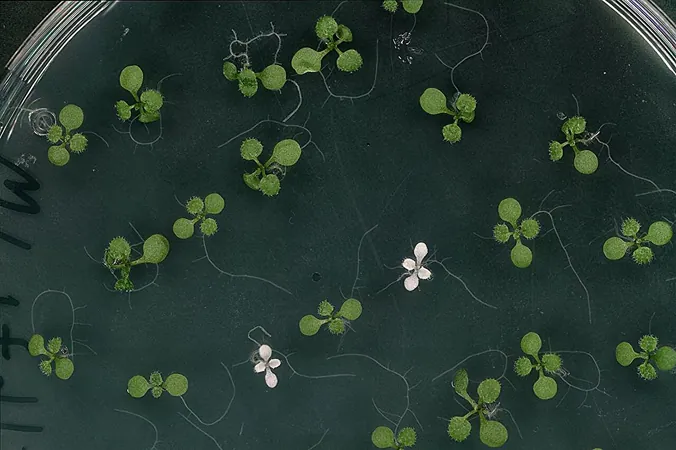
The research team meticulously screened various miniature CRISPR systems before selecting ISYmu1 for its power and efficiency. Once the tobacco rattle virus was engineered to deliver this enzyme into Arabidopsis plants, the virus effectively spread throughout, ensuring that the gene editing occurred precisely in the germ cells. The result? Clear visual markers confirmed that the gene edits were not just successful—they were inherited.
The Excitement of Future Prospects
This remarkable breakthrough heralds a new era of precision farming. With potential applications across over 400 plant species, including vital crops like tomatoes, this technology could lead to crops with higher yields, enhanced nutraceutical values, and stronger resilience against climate shifts—a game-changer for food production.
Building Collaborative Futures
As Jacobsen highlights, the collaboration between Doudna and Banfield’s groups showcases the power of teamwork in science. Their shared expertise not only pushes the boundaries of gene editing but also aims to target crops that are often overlooked in investment and research.
What Lies Ahead?
The team is eager to expand this technology to additional crops. Currently, their system allows for a single DNA change at a time, but plans are underway to enhance its capabilities for multiple genome edits simultaneously—a significant leap towards more advanced agricultural solutions.
In Conclusion: A Bright Future for Crops!
This breakthrough is more than just a scientific advancement; it represents hope for farmers and consumers worldwide. As researchers refine this tool and test it on a wider range of crops, the potential to revolutionize agriculture has never been closer to reality.
 Brasil (PT)
 Canada (EN)
 Chile (ES)
 Česko (CS)
 대한민국 (KO)
 España (ES)
 France (FR)
 Hong Kong (EN)
 Italia (IT)
 日本 (JA)
 Magyarország (HU)
 Norge (NO)
 Polska (PL)
 Schweiz (DE)
 Singapore (EN)
 Sverige (SV)
 Suomi (FI)
 Türkiye (TR)
 الإمارات العربية المتحدة (AR)