Revolutionary Discovery: Gene Syntax Determines Variability in Synthetic Plasmids!
2025-04-22
Author: Nur
A Game-Changing Breakthrough in Genetic Engineering
Engineers and biologists at Dartmouth College have made a stunning revelation: just like the arrangement of words in a sentence changes its meaning, the order of genes within a plasmid—termed gene syntax—can dramatically alter gene expression levels, consistency across individual cells, and interactions with neighboring genes.
Unraveling the Mysteries of Gene Behavior
Surprisingly, this groundbreaking study shows that although the DNA sequences of the genes themselves remain unchanged, tweaking their arrangement leads to significant variations in how these genes manifest their functions. This discovery sheds light on the complex behavior of transcriptional machinery and how varied gene expression actually works.
Understanding Plasmids: Essential Genetic Tools
Plasmids are small, circular DNA molecules critical for genetic engineering, often employed by scientists to introduce beneficial genes into cells. Yet, the unpredictable nature of synthetic plasmids has historically created challenges in biotechnology, leaving many researchers stuck in a frustrating cycle of guesswork.
Disruptive Findings on Gene Syntax
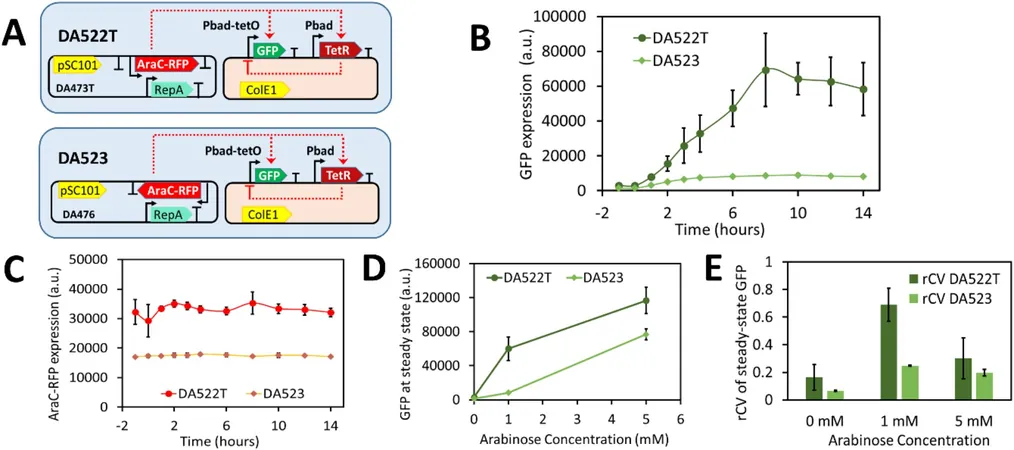
In their pivotal study, "Gene syntaxes modulate gene expression and circuit behavior on plasmids," researchers meticulously analyzed how the order and orientation of genes in plasmids can affect gene behavior. By using E. coli NEB 10-beta cells, they created synthetic plasmids with fluorescent reporter genes positioned differently while keeping other regulatory elements identical.
The investigation examined seven unique plasmid configurations, revealing that even slight changes in gene syntax produced substantial differences in gene expression levels—ranging by more than 1.8-fold!
Key Insights on Gene Arrangement
The study also found that genes aligned with the plasmid's origin of replication showed consistently higher expression than those arranged oppositely. Moreover, genes placed closely together expressed more robustly than when positioned apart, highlighting the intricate relationship between gene arrangement and performance.
Breaking Down Variability
Interestingly, while expression variability remained stable across many constructs, the intrinsic and extrinsic noise levels varied based on gene syntax. This discovery indicates that gene syntax is a crucial element in reducing unwanted variability in synthetic systems.
Implications for Synthetic Biology
This revolutionary work suggests gene syntax should be seen not as a trivial detail but as an essential variable in plasmid design. By understanding spatial factors, synthetic biologists can significantly enhance the reliability of their genetic tools, saving both time and resources.
Conclusion: The Path Forward for Genetic Engineering
Dartmouth College's pivotal study offers fresh insights into how gene syntax can optimize the predictability and efficiency of synthetic biology applications. As researchers continue to explore these dynamics, the future of genetic engineering looks not only more reliable but also incredibly promising!
 Brasil (PT)
 Canada (EN)
 Chile (ES)
 Česko (CS)
 대한민국 (KO)
 España (ES)
 France (FR)
 Hong Kong (EN)
 Italia (IT)
 日本 (JA)
 Magyarország (HU)
 Norge (NO)
 Polska (PL)
 Schweiz (DE)
 Singapore (EN)
 Sverige (SV)
 Suomi (FI)
 Türkiye (TR)
 الإمارات العربية المتحدة (AR)