Revolutionary Discovery: Hydrogen's Hidden Role in Earth's Formation
2025-04-21
Author: John Tan
Unveiling the Mysteries of Enstatite Chondrites
Enstatite chondrites (ECs) have long been believed to represent Earth's fundamental building blocks, thanks to their isotopic similarities to terrestrial rocks. Traditionally viewed as nearly devoid of water, these meteorites have recently sparked intrigue among scientists.
A Surprise in the Hydrogen Content
New research suggests that ECs might actually contain significant hydrogen supplies—enough to potentially explain the abundance of water on Earth today. This discovery has raised critical questions about the role of these meteorites in the hydrogen budget of our planet.
Exploration Through Advanced Techniques
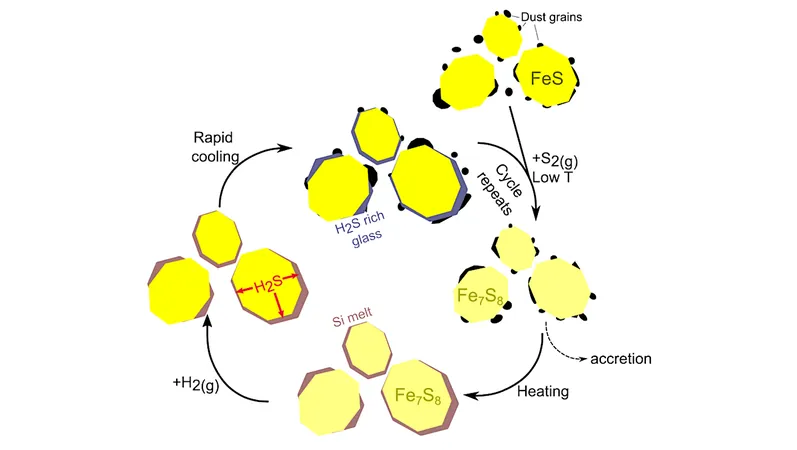
Utilizing cutting-edge sulfur X-ray absorption near edge structure (S-XANES) spectroscopy, researchers have probed the hydrogen content of ECs. Astonishingly, they found hydrogen bonded to sulfur is widespread throughout these meteorites. The fine matrix of the ECs holds nearly ten times more hydrogen sulfide (H₂S) compared to the chondrule mesostasis.
The Role of Pyrrhotite in Hydrogen Formation
Key to this discovery is the presence of micrometer-scale pyrrhotite (Fe₁₋ₓS). This mineral seems to act as a catalyst that facilitates reactions with hydrogen gas (H₂) at high temperatures, forming dissolved H₂S in nearby molten silicate materials. Upon rapid cooling, this mixture can create pyrrhotite encapsulated in finely textured silicate-rich glass that retains H₂S.
Implications for Earth's History
These groundbreaking findings imply that hydrogen in ECs is more prevalent than previously thought, suggesting a systematic rather than random origin for this crucial element on Earth. As researchers continue to unravel these secrets, the future holds the promise of understanding not just the origins of hydrogen, but also the broader processes that shaped our planet.
A Glimpse into the Past and Beyond
The implications of this research extend beyond Earth, hinting at the potential for hydrogen-rich minerals to exist on other celestial bodies. As we look to the stars, the discovery of hydrogen's robust role in planetary formation could reshape our understanding of the universe.

 Brasil (PT)
 Canada (EN)
 Chile (ES)
 Česko (CS)
 대한민국 (KO)
 España (ES)
 France (FR)
 Hong Kong (EN)
 Italia (IT)
 日本 (JA)
 Magyarország (HU)
 Norge (NO)
 Polska (PL)
 Schweiz (DE)
 Singapore (EN)
 Sverige (SV)
 Suomi (FI)
 Türkiye (TR)
 الإمارات العربية المتحدة (AR)