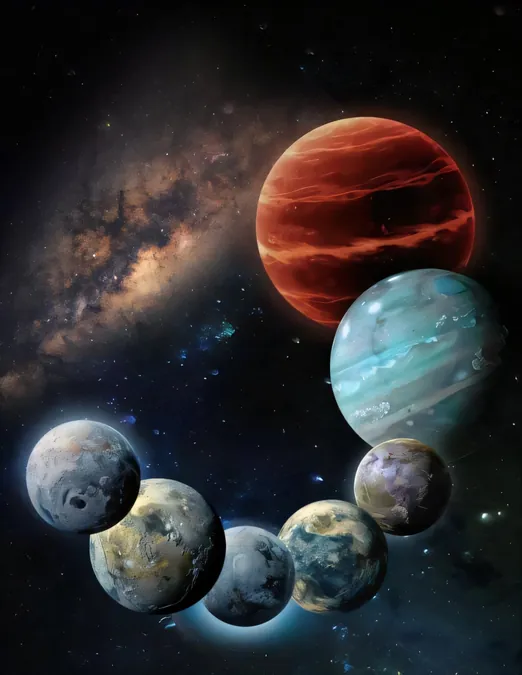
Revolutionary Discovery: Super-Earths Are More Common Than We Thought!
2025-04-24
Author: Yu
An Astounding Finding in Exoplanet Research
In a groundbreaking revelation, a global team of astronomers from the Center for Astrophysics | Harvard & Smithsonian has unveiled an extraordinary planet—dubbed a 'super-Earth'—that is approximately twice the size of our own Earth. This remarkable planetary body orbits its star much further out than Saturn does from our Sun.
What Is a Super-Earth?
A super-Earth is defined as a planet larger than Earth but smaller than Neptune, and this new discovery challenges previous notions of planet formation in our universe. Lead author Weicheng Zang remarked, "We found a super-Earth in a region of space previously thought to house only massive planets hundreds or thousands of times larger than Earth!" This discovery has significant implications for understanding the diversity of planetary systems beyond our own.
Diving Deeper into the Milky Way's Planetary Population
The newly discovered super-Earth forms part of a larger study focusing on the population of planets across the Milky Way galaxy. By examining the masses of numerous planets relative to their host stars, this research sheds light on the widespread existence of these intriguing worlds.
Innovative Techniques Leading the Way
Utilizing the innovative technique of microlensing, where light from distant celestial objects is amplified by intervening bodies like planets, researchers targeted planets situated between the orbits of Earth and Saturn. This extensive study has resulted in three times more planet discoveries than previous microlensing efforts, featuring planets much smaller than those typically detected before.
A Groundbreaking Collaborative Effort
The findings originated from data collected by the Korea Microlensing Telescope Network (KMTNet), a consortium of three telescopes located in Chile, South Africa, and Australia, providing continuous monitoring of the night sky. Professor Shude Mao from Tsinghua and Westlake University in China commented, "The current data offers insights into the formation of colder planets. As our sample grows, we will gain more stringent constraints on how these planets evolve."
Challenging Our Solar System's Dominance
While our solar system consists of four inner rocky planets and four outer gas giants, previous research indicated various systems showcase a mix of small, medium, and large planets in different orbits. The latest findings indicate that super-Earths are not just anomalies; they are prevalent even in the outer regions of other solar systems.
A New Perspective on Planetary Systems
Co-author Jennifer Yee emphasized that the data indicates a remarkable abundance of planets, particularly super-Earths, in orbits outside of Earth's path. Youn Kil Jung, another co-author, elaborated, "Most planetary systems may not resemble our solar system, especially in the vicinity of Jupiter-like orbits!"
Uncovering the Balance of Super-Earths and Neptune-sized Planets
Research efforts are ongoing to determine the ratio of super-Earths compared to Neptune-sized planets, and early findings suggest there are at least as many super-Earths as their larger counterparts. This study, bringing together contributions from several CfA scientists, including In-Gu Shin and Hangyue Wang, could reshape our understanding of planetary diversity in the universe.
Looking Ahead in Exoplanet Research
The collaborative efforts of KMTNet, along with the Optical Gravitational Lens Experiment (OGLE) and the Microlensing Observations in Astrophysics (MOA), are setting the stage for an exciting future in planetary science. Stay tuned as we unravel the mysteries of super-Earths and redefine our place in the cosmos!
 Brasil (PT)
 Canada (EN)
 Chile (ES)
 Česko (CS)
 대한민국 (KO)
 España (ES)
 France (FR)
 Hong Kong (EN)
 Italia (IT)
 日本 (JA)
 Magyarország (HU)
 Norge (NO)
 Polska (PL)
 Schweiz (DE)
 Singapore (EN)
 Sverige (SV)
 Suomi (FI)
 Türkiye (TR)
 الإمارات العربية المتحدة (AR)