Revolutionary Findings: Early Earth May Have Been Wet All Along!
2025-04-21
Author: Nur
New Study Shakes Up Theories About Early Earth
In a groundbreaking revelation, new research indicates that early Earth may have been much wetter than scientists had previously believed. This stunning finding could change the narrative about how our planet acquired its water.
Meteorite Insights Redefine Earth's History
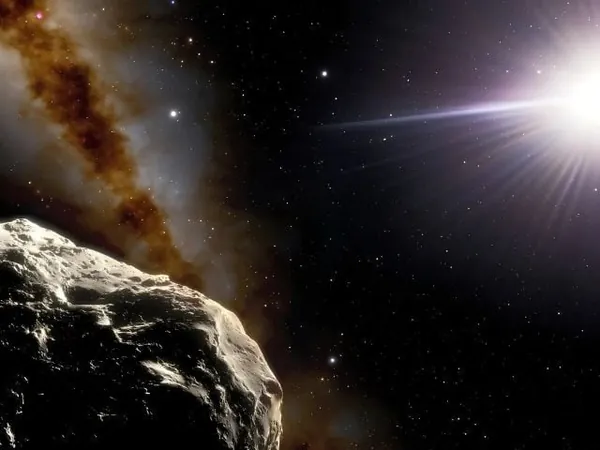
A team from the University of Oxford analyzed a rare meteorite, known as an enstatite chondrite, dated at a remarkable 4.6 billion years old. Their study, published in the journal "Icarus," suggests that intrinsic hydrogen present in this ancient rock implies Earth's building blocks included enough hydrogen to generate water molecules from the very start, challenging the idea that water only arrived via asteroid impacts.
A Surprising Twist on Earth's Formation
Lead author Tom Barrett explained that until now, it was thought Earth's water resulted from lucky asteroid encounters. "But our findings suggest that the materials that formed Earth itself contained substantial amounts of hydrogen and oxygen. This means our planet may have been hydrated from its inception," said Barrett.
Advanced Methods Uncover Hidden Elements
To detect the elusive hydrogen, the researchers employed the sophisticated X-ray Absorption Near Edge Structure (XANES) spectroscopy using a particle accelerator, a complex technique not typically found in a garage lab.
Implications for Planetary Science—But Not Without Caution
While this discovery has implications for understanding planetary development, Barrett cautioned it doesn’t guarantee that life could have formed earlier. He noted, "A planet’s habitability may hinge more on its evolution over time than on its original materials." His next step involves studying more meteorites to gauge the total hydrogen available on early Earth.
Skepticism Amidst Excitement
James Bryson, co-author of the study, reinforced the belief that ancient meteorites have brought valuable insights into Earth's formation, suggesting these building blocks were richer in hydrogen than previously assumed. However, some experts remain skeptical. Matt Genge, a planetary scientist at Imperial College London, acknowledged the findings are intriguing but lack enough strength to overturn established theories regarding Earth's water origins.
Addressing Valid Concerns About Contamination
Despite skepticism, Bryson defended their research, asserting that they made extensive efforts to minimize earthly contamination in their findings. He estimated that only about 15% of the hydrogen found within the meteorite could have come from Earth, suggesting that the majority was primordial.
Conclusion: A New Chapter in Earth’s Story?
As scientists continue to delve into Earth's enigmatic history, this research offers fascinating insights into our planet's potential to support life much earlier than previously thought. The debate isn't over, but the implications of this study certainly open new avenues for exploration and understanding.
 Brasil (PT)
 Canada (EN)
 Chile (ES)
 Česko (CS)
 대한민국 (KO)
 España (ES)
 France (FR)
 Hong Kong (EN)
 Italia (IT)
 日本 (JA)
 Magyarország (HU)
 Norge (NO)
 Polska (PL)
 Schweiz (DE)
 Singapore (EN)
 Sverige (SV)
 Suomi (FI)
 Türkiye (TR)
 الإمارات العربية المتحدة (AR)