Revolutionary Findings: Ice Sublimation in the HD 100453 Disk Unveils Hidden Organic Treasures
2025-04-22
Author: Mei
Unlocking Cosmic Secrets in Young Star Disks
Scientists have turned their gaze toward the luminous young A-type stars, where protoplanetary disks serve as prime hunting grounds for complex organic molecules (COMs). These cosmic laboratories hold the key to understanding how planets form from the material swirling around nascent stars.
Groundbreaking ALMA Observations of HD 100453 Disk
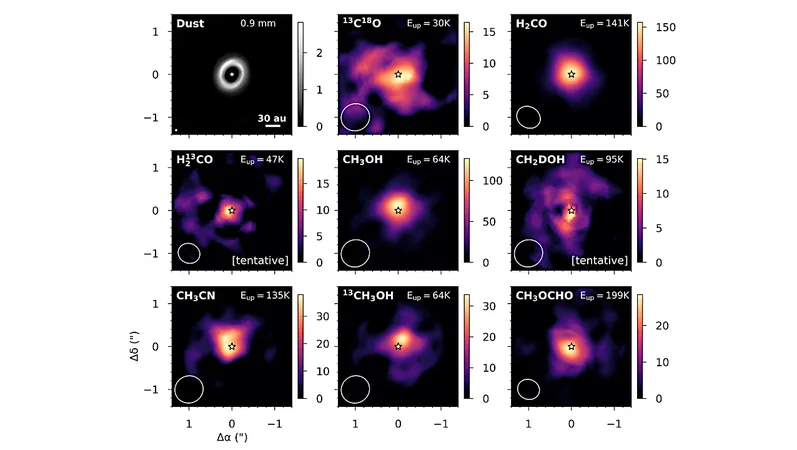
Through the incredible capabilities of the Atacama Large Millimeter/submillimeter Array (ALMA), researchers have examined the Herbig Ae disk known as HD 100453, revealing a treasure trove of COMs emerging from the edge of the dust cavity. Among the most intriguing findings is the detection of methanol (CH3OH) and its isotopologue, 13CH3OH, marking a monumental first for Class II disks. This discovery indicates a threefold increase in carbon-13 presence in these complex organics, hinting at a rich molecular history.
New Insights into Deuteration in Cosmic Ice
Additionally, scientists have tentatively identified CH2DOH, leading to an impressive deuterium-to-hydrogen ratio of 1-2%. This finding aligns with expectations of deuterium enhancement from low-temperature methanol formation in molecular clouds as well as the levels of deuteration observed in comets.
Organic Abundances: A Closer Look at Methyl-Formate
One of the more surprising results is the detection of methyl-formate (CH3OCHO), though it appears to be at a mere few percent of the level of methanol. This number is significantly lower than previously reported for other organic-rich Herbig Ae disks but it is consistent with organic abundance patterns seen in the initial phases of star formation.
Implications for Planet Formation and Interstellar Chemistry
The findings from the HD 100453 disk provide compelling evidence that the materials crucial for planet and comet formation are deeply rooted in interstellar ices, affirming that much of the organic ice composition from the interstellar medium can withstand the tumultuous beginnings of planetary systems. This research opens up exciting avenues to explore how life’s building blocks could survive the birth pangs of new worlds.
 Brasil (PT)
 Canada (EN)
 Chile (ES)
 Česko (CS)
 대한민국 (KO)
 España (ES)
 France (FR)
 Hong Kong (EN)
 Italia (IT)
 日本 (JA)
 Magyarország (HU)
 Norge (NO)
 Polska (PL)
 Schweiz (DE)
 Singapore (EN)
 Sverige (SV)
 Suomi (FI)
 Türkiye (TR)
 الإمارات العربية المتحدة (AR)