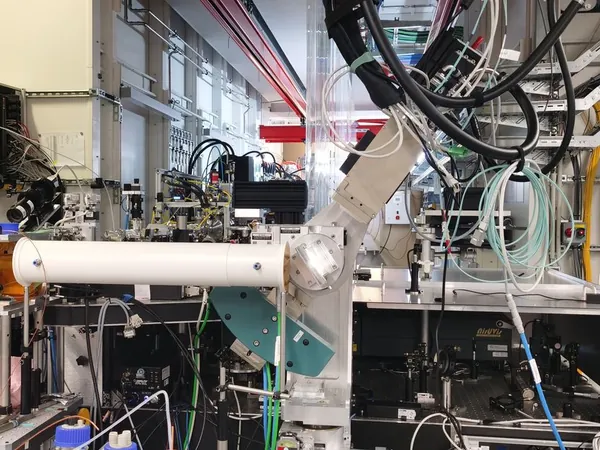
Revolutionary High-Energy Spectrometer Unleashed at European XFEL
2025-04-22
Author: Rajesh
Unlocking Atomic Secrets with Cutting-Edge Technology
In the quest to decode the fundamental mysteries of atoms and materials, scientists have long relied on specialized tools called spectrometers. These remarkable devices capture the light emitted by objects, revealing crucial insights about the physical processes occurring within. Among the most powerful forms of light used for these analyses is high-energy X-ray radiation, which can penetrate materials deeply, uncovering details unique to each atomic species. Although invisible to the naked eye, this light can be harnessed and measured with advanced spectrometer technology.
The Challenge of High-Energy X-rays
Traditional X-ray spectrometers typically operate using Bragg geometry, where X-ray light interacts with precisely cut silicon or germanium crystals. However, as X-ray energy levels soar, their interactions with these materials decline, making high-energy measurements increasingly tricky. Most existing X-ray spectrometers lose efficacy above 15 kiloelectronvolts (keV), as much of the light passes through without being utilized.
Introducing HELIOS: The Future of Spectrometry
Now, researchers at the European XFEL's FXE instrument have transformed the landscape with a groundbreaking spectrometer that thrives at energies well beyond 15 keV. Operating in a novel Laue geometry, this innovative device allows X-rays to pass through and diffract off atomic layers in a way that enhances efficiency as energy increases. With a fixed curvature and minimal surface distortions, the new design significantly simplifies both setup and measurement processes, as highlighted by Frederico Lima, a prominent scientist at the FXE instrument. This leap in design outperforms previous models that utilized dynamically curved Laue analysers.
HELIOS: Unprecedented Precision and Capability
Enter the High Energy Laue X-ray Emission Spectrometer (HELIOS)—now operational and accessible to users at the European XFEL. This state-of-the-art device delivers an astounding precision of about 1.2 x 10⁻⁴ at a photon energy of approximately 18.6 keV, boasting signal strengths that are 4 to 22 times greater than conventional methods. This heightened capability is pivotal for investigating elusive electronic transitions within 4d transition metals—technologically vital elements like niobium, molybdenum, ruthenium, palladium, and silver.
Opening New Frontiers in Research
"Our new spectrometer paves the way for unparalleled spectroscopic explorations at high X-ray energies—potentials found exclusively at the European XFEL," Lima remarks. This opens floodgates for groundbreaking studies, including the photocatalytic properties of nanoparticles linked to 4d metals, advancements in dye sensitization for solar energy applications, and deep dives into strongly correlated materials that hold promise for future superconductors, battery cathodes, and anodes facilitating efficient energy storage.

 Brasil (PT)
 Canada (EN)
 Chile (ES)
 Česko (CS)
 대한민국 (KO)
 España (ES)
 France (FR)
 Hong Kong (EN)
 Italia (IT)
 日本 (JA)
 Magyarország (HU)
 Norge (NO)
 Polska (PL)
 Schweiz (DE)
 Singapore (EN)
 Sverige (SV)
 Suomi (FI)
 Türkiye (TR)
 الإمارات العربية المتحدة (AR)