Revolutionary MIT Breakthrough: Meet the Stretchy, Super-Strong Metamaterials!
2025-04-23
Author: Ming
MIT Engineers Create Groundbreaking Stretchy Metamaterials
In a world where strength often comes at the cost of flexibility, MIT engineers are flipping the script with their latest invention: synthetic metamaterials that can both stretch and endure incredible pressure. Traditionally, the mantra has been 'stronger is better,' but this innovative research shatters that concept by introducing materials that combine the best of both worlds.
The Magic of Design: A Unique Double Network Structure
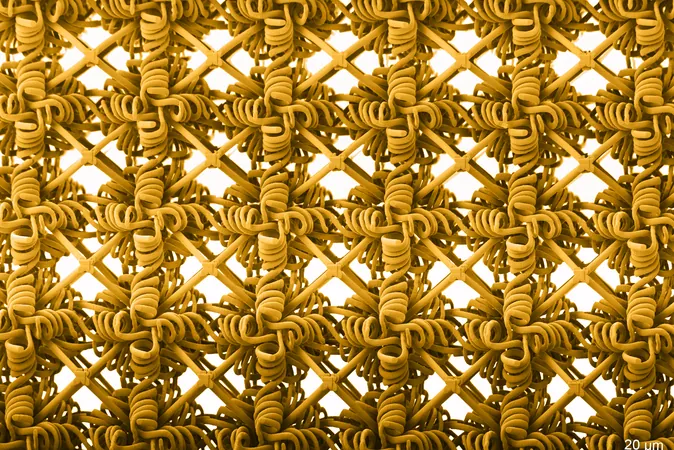
This new metamaterial's remarkable properties stem from a unique design that employs a double network structure. While the base material is typically rigid and brittle, MIT's engineers have cleverly integrated stiff microscopic struts with a softer woven architecture. The result? A hybrid material that can stretch over four times its original size without succumbing to failure, unlike traditional polymers that shatter easily.
Versatile Applications Await
The potential uses for these new materials are virtually limitless. Imagine tear-resistant textiles, flexible electronics, and robust scaffolds for cell growth in tissue repair. MIT Professor Carlos Portela enthusiastically shares, 'We are opening up new territory for metamaterials. The possibilities for applying this dual-network design to metals and ceramics could lead to materials that have greater durability and flexibility than we've ever seen before.'
Inspiration from Hydrogels
What led to this breakthrough? Portela and his team were inspired by hydrogels—soft, water-rich materials that have incredible stretchability and toughness. By adapting ideas from hydrogel research, the team designed a metamaterial that marries stiffness with flexibility, paving the way for this innovative double-network structure.
Strut, Weave, and Conquer!
The new material is crafted using two intricate architectures: a rigid framework of struts and a coiled pattern that weaves around them. By employing a sophisticated technique called two-photon lithography, the team created samples of varying sizes that were rigorously stress-tested. Remarkably, these metamaterials could stretch three times their length, outperforming traditional designs by a staggering tenfold!
Engineering the Future: Enhanced Performance with Strategic Defects
The team has even discovered that introducing specific 'defects' into the material can enhance its performance, increasing both flexibility and resistance to tearing. As co-author James Utama Surjadi explains, 'Adding defects doesn't make the material worse; it nearly doubles its stretchability and triples energy dissipation capabilities!' This finding opens up new avenues for engineers to explore multifaceted applications.
A Bright Horizon for Material Science
Looking ahead, Portela and his team aim to broaden the horizons of these metamaterials, making them not just mechanically strong but also responsive to environmental changes. The potential to create materials that adapt based on temperature could revolutionize how we think about textiles and beyond. With this groundbreaking research supported by key institutions, the future of metamaterials is bright and full of exciting possibilities!
 Brasil (PT)
 Canada (EN)
 Chile (ES)
 Česko (CS)
 대한민국 (KO)
 España (ES)
 France (FR)
 Hong Kong (EN)
 Italia (IT)
 日本 (JA)
 Magyarország (HU)
 Norge (NO)
 Polska (PL)
 Schweiz (DE)
 Singapore (EN)
 Sverige (SV)
 Suomi (FI)
 Türkiye (TR)
 الإمارات العربية المتحدة (AR)