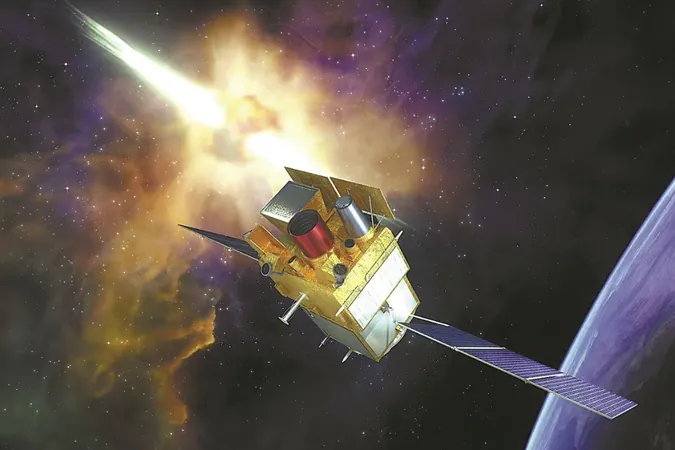
Revolutionary Satellite Unravels Cosmic Mysteries
2025-04-25
Author: Jia
A state-of-the-art astronomical satellite, born from a groundbreaking partnership between Chinese and French scientists, is shaking up the scientific world with astounding discoveries—just 10 months after its launch!
Introducing SVOM: The Ultimate Gamma-Ray Burst Hunter
The Space-based Multi-band Variable Object Monitor (SVOM) soared into orbit on June 22, 2024, following nearly two decades of innovative collaboration between the China National Space Administration and France's National Center for Space Studies. During China's 10th Space Day festivities in Shanghai, SVOM proudly unveiled its initial scientific findings, signaling a monumental leap in our understanding of gamma-ray bursts—the most extreme explosions since the Big Bang.
Unlocking Cosmic Secrets
SVOM has already captured over 100 gamma-ray bursts, establishing itself as the world's most powerful "gamma-ray burst catcher." Among its most mesmerizing discoveries is GRB250314A—a burst dating back to just 730 million years after the universe's inception, roughly 13 billion years ago. Scientists speculate this burst may result from one of the universe's earliest stars collapsing into a black hole or neutron star, potentially offering crucial insights into the early cosmic era.
A Historic Discovery
Additionally, SVOM recorded GRB241105A, now recognized as the most distant short-duration gamma-ray burst, showcasing the satellite's extraordinary capabilities. Wei Jianyan, principal investigator for the Chinese team, noted, "These findings not only demonstrate the satellite's exceptional performance but also provide a new lens for exploring the birth of early stars and the formation of black holes."
Challenging Established Theories
What's more, SVOM has detected several peculiar gamma-ray bursts that challenge existing theories in high-energy astrophysics, encouraging scientists to rethink their understanding of the universe.
A Global Collaboration
The SVOM project, initiated in 2005, represents a remarkable collaboration among experts from various institutions, including the Research Institute in Astrophysics and Planetology in Toulouse, France, and the Institute of High Energy Physics in Beijing. Weighing 930 kilograms, this innovative satellite was developed by the Chinese Academy of Sciences and boasts four scientific payloads, a testament to the collaborative effort behind its creation.
Immediate Response Capabilities
SVOM is not just an impressive technological feat; it’s part of a rapid and sophisticated observational system linked to over 40 ground communication stations worldwide. Zhang Yonghe, the satellite's project manager, proudly stated, "The system can relay observation commands to SVOM in the time it takes to enjoy a cup of coffee!" Once a gamma-ray burst is detected, the satellite coordinates both space and ground-based observations in under 10 minutes.
A Bright Future in Astrophysics
With a minimum operational lifespan of three years, SVOM is poised to dramatically enhance our knowledge of high-energy astrophysics. Scientists are eager to explore how the first stars formed and disappeared, delve into black hole mechanics, identify electromagnetic counterparts to gravitational wave events, and refine existing theories on the universe's early evolution.
In a fitting conclusion to its mission, the satellite was officially handed over to the National Astronomical Observatories of the Chinese Academy of Sciences, marking the dawn of a new era in cosmic exploration.

 Brasil (PT)
 Canada (EN)
 Chile (ES)
 Česko (CS)
 대한민국 (KO)
 España (ES)
 France (FR)
 Hong Kong (EN)
 Italia (IT)
 日本 (JA)
 Magyarország (HU)
 Norge (NO)
 Polska (PL)
 Schweiz (DE)
 Singapore (EN)
 Sverige (SV)
 Suomi (FI)
 Türkiye (TR)
 الإمارات العربية المتحدة (AR)