Revolutionary Space Laboratory Aims to Grow Food in Orbit!
2025-04-25
Author: Ming
Frontier Space's Bold New Mission Takes Flight
In a groundbreaking leap for both space exploration and food production, Frontier Space, a spin-out company from Cranfield University, has successfully launched a fully automated laboratory into orbit. This venture is part of a European Space Agency initiative aimed at determining the feasibility of producing lab-grown food in the unique environment of microgravity.
Launched Aboard SpaceX: A New Era of In-Orbit Food Production
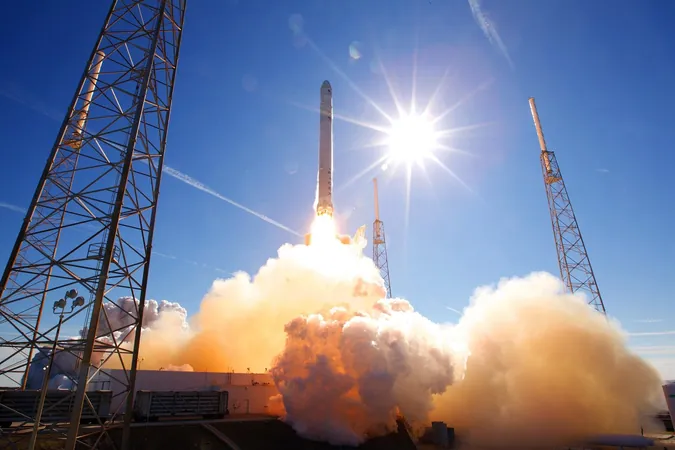
The cutting-edge laboratory, launched on April 21, 2025, aboard a SpaceX Falcon 9 rocket, carries three innovative payloads, all encased in a re-entry capsule designed by German startup ATMOS Space Cargo. While this mission may not seem massive, it showcases immense potential for future applications in space biotechnology.
What Is SpaceLab?
Frontier Space is spearheading the industrialization of biotechnology in space with its revolutionary SpaceLab—an adaptable, modular, autonomous lab-in-a-box concept. Although this mission doesn't utilize the complete SpaceLab, it employs a specially tailored device called an EGGS (Early Gen micro-Gravity Service) payload, designed to test specific technologies.
A Culinary Experiment Among the Stars
One of the mission's most exciting payloads comes from Imperial College London, where researchers aim to transport biological specimens into space and then analyze them upon return to Earth. Previously, these scientists have engineered food from yeast using a method known as "precision fermentation," and now they're eager to see how those processes adapt to the challenges of microgravity.
The Future of Space Food: Paving the Way for Self-Sufficient Missions
If this experiment succeeds, it could revolutionize how astronauts sustain themselves on long missions, allowing them to grow essential supplies instead of relying entirely on Earth shipments. With food costs for astronauts soaring as high as £20,000 per day, cultivating resources in space could drastically lower those expenses.
Turning Dreams into Reality
As Dr. Rodrigo Ledesma-Amaro from Imperial College puts it, "Imagining a future where we can feed ourselves with just a handful of cultivated cells from freely available resources could make interstellar travel much more feasible."
A Validation of Innovation
Frontier Space emerged from Cranfield University in 2021, and its progress is being hailed as a testament to the university's pioneering research. Professor David Cullen, an expert in Astrobiology and Space Biotechnology, expressed pride in witnessing their technology transition from academic theory to real-world application. He remarked on how essential Frontier Space's work is for the rapid growth of advanced bioscience and biotechnology in extraterrestrial environments.
 Brasil (PT)
 Canada (EN)
 Chile (ES)
 Česko (CS)
 대한민국 (KO)
 España (ES)
 France (FR)
 Hong Kong (EN)
 Italia (IT)
 日本 (JA)
 Magyarország (HU)
 Norge (NO)
 Polska (PL)
 Schweiz (DE)
 Singapore (EN)
 Sverige (SV)
 Suomi (FI)
 Türkiye (TR)
 الإمارات العربية المتحدة (AR)