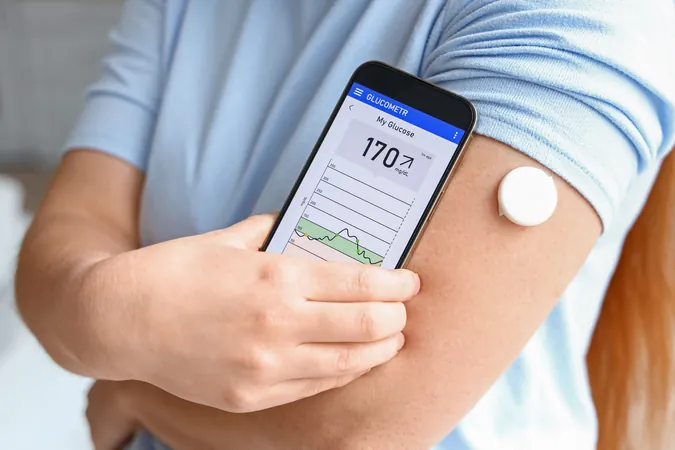
Revolutionary Study Reveals How Continuous Glucose Monitors Could Predict Type 2 Diabetes Early!
2025-04-22
Author: Jia
A Game-Changer in Diabetes Detection!
Imagine a world where diabetes could be detected long before it poses any threat to your health! A groundbreaking study has unveiled that Continuous Glucose Monitors (CGMs) can reveal crucial insights into blood sugar regulation, even for those who have never been diagnosed with diabetes.
How Does It Work?
According to the research published in Communications Medicine, CGMs provide data that includes the autocorrelation function of glucose levels, which can effectively predict a person's ability to filter glucose. This innovative method bypasses traditional reliance on blood samples, making early detection both simpler and far more efficient.
Dr. Shinya Kuroda from the University of Tokyo emphasized, “Traditional diabetes tests fall short in capturing how glucose regulation fluctuates in real-time physiological conditions.” This means that while current tests are valuable, they might miss subtle signs of diabetes that could be caught through continuous monitoring.
The Growing Diabetes Epidemic
With diabetes on the rise globally, detecting glucose regulation issues early is more critical than ever. CGMs have shown remarkable accuracy in identifying glucose fluctuations in individuals who typically present normal results. This raises the alarm that our healthcare systems might be overlooking early indicators of diabetes.
The Study Breakdown
In this pivotal research, 64 individuals without diabetes were assessed using a novel framework that analyzed their glucose homeostasis. They were recruited from Kobe University Hospital in Japan between 2016 and 2018.
The study went beyond standard tests by employing complex algorithms that combined CGM data with glucose metrics, leading to the discovery that the autocorrelation function of glucose levels is closely linked to the Disposition Index (DI)—a critical diabetes risk predictor.
Unveiling Hidden Risks!
Dr. Kuroda noted a significant finding: “Our new algorithm has identified individuals with impaired glycemic control even when they appeared ‘normal’ in standard tests.” This capability could usher in a new era of preventive healthcare—intervening before diabetes even develops.
The Future of Diabetes Screening
This new methodology isn’t just effective for spotting diabetes; it has also proven superior in predicting complications related to diabetes, such as coronary artery disease. To make this groundbreaking technology more accessible, researchers have even created a user-friendly web application for health providers and individuals to track their glucose indices easily.
Dr. Kuroda concludes with a vision: “Our goal is to deliver a practical tool for widespread diabetes screening. By facilitating early detection, we aim not just to prevent diabetes but to minimize the long-term complications that accompany this disease.”
A Call to Action!
As this study makes waves across the medical community, it's a reminder of the urgent need for innovative approaches to keep diabetes at bay. With CGMs, we may finally have the key to unlocking early intervention—an opportunity that could change countless lives in the battle against diabetes!
 Brasil (PT)
 Canada (EN)
 Chile (ES)
 Česko (CS)
 대한민국 (KO)
 España (ES)
 France (FR)
 Hong Kong (EN)
 Italia (IT)
 日本 (JA)
 Magyarország (HU)
 Norge (NO)
 Polska (PL)
 Schweiz (DE)
 Singapore (EN)
 Sverige (SV)
 Suomi (FI)
 Türkiye (TR)
 الإمارات العربية المتحدة (AR)