Revolutionary Study Unveils Secrets of a Distant Supernova Remnant
2025-04-22
Author: Rajesh
Astronomers Unlock Mysteries of MC SNR J0519-6902
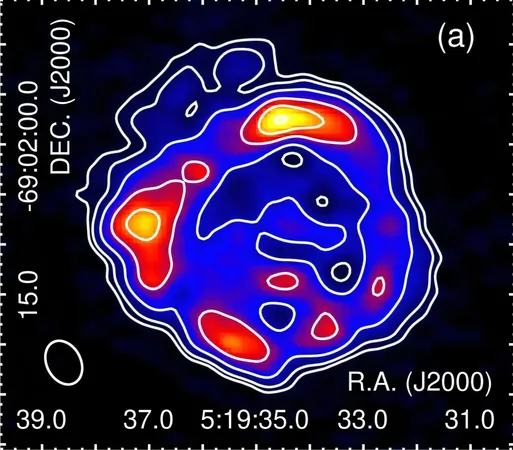
In a groundbreaking new study, an international team of astronomers has tapped into the power of the Australia Telescope Compact Array (ATCA) and the Parkes 64-m telescope to explore the supernova remnant MC SNR J0519-6902, located in the captivating Large Magellanic Cloud (LMC). Released on April 16 as a preprint, this research shines a light on the enigmatic properties of this celestial wonder.
What Are Supernova Remnants?
Supernova remnants, often referred to as SNRs, are vast, expanding structures that emerge following a spectacular supernova explosion. These remnants contain material ejected from the explosion itself, along with interstellar matter that has been swept up by shockwaves from the dying star.
The Discovery of MC SNR J0519-6902
First identified in 1981, MC SNR J0519-6902—also known as LHG 26—boasts a mesmerizing diameter of about 26 light-years. Its radio wave emissions form a ring-like structure dotted with three strikingly bright regions.
Unraveling the Age Mystery
Despite previous studies, critical properties of MC SNR J0519-6902 remain elusive, with estimates of its age varying wildly between 450 and 1,500 years. This remnant is believed to have originated from a type Ia supernova, with its progenitor star’s mass estimated to fall between 1.2 and 4.0 solar masses.
Innovative Observations to the Rescue
To clarify these uncertainties, lead researcher Rami Z. E. Alsaberi, along with his team from Gifu University in Japan, conducted comprehensive observations using the ATCA and Parkes telescope, complemented by data from the Hubble Space Telescope and Chandra X-ray Observatory.
Groundbreaking Findings
Their observations revealed that the average fractional polarization of MC SNR J0519-6902 is around 5 to 6 percent at frequencies of 5,500 and 9,000 MHz, comparable to younger SNRs like N 103B and G1.9+0.3 in our Milky Way. Moreover, the spectral index was measured at -0.62—aligning it with other younger remnants such as Kepler's SNR and SN 1006.
Magnetic Strength and Evolution
The estimated magnetic field strength of MC SNR J0519-6902 ranges from 10 to 100 µG, echoing values found in younger remnants including Kepler's SNR. The study authors suggest that these findings collectively point to MC SNR J0519-6902 being a relatively young remnant on the cusp of transitioning from its free expansion phase into the early stages of the Sedov phase.
A Celestial Journey Continues
"MC SNR J0519-6902’s position on Σ–D tracks indicates it might be nearing the end of its free expansion phase, poised at the brink of further evolutionary transformation," the researchers concluded. With each new discovery, the story of this distant supernova remnant continues to unfold, offering tantalizing glimpses into the life cycle of stars and the dynamics of our universe.

 Brasil (PT)
 Canada (EN)
 Chile (ES)
 Česko (CS)
 대한민국 (KO)
 España (ES)
 France (FR)
 Hong Kong (EN)
 Italia (IT)
 日本 (JA)
 Magyarország (HU)
 Norge (NO)
 Polska (PL)
 Schweiz (DE)
 Singapore (EN)
 Sverige (SV)
 Suomi (FI)
 Türkiye (TR)
 الإمارات العربية المتحدة (AR)