Revolutionary Tool Transforms Neuroscience Research in Resource-Limited Settings!
2025-03-25
Author: Daniel
Revolutionary Tool Transforms Neuroscience Research in Resource-Limited Settings!
A groundbreaking, cost-effective analysis tool for studying fruit flies—Drosophila melanogaster—has just been unveiled, potentially reshaping neuroscience research in low-income environments and field studies. This innovative approach allows researchers to investigate the genetic and neural mechanisms behind complex social behaviors like aggression and courtship without the burden of traditional, expensive laboratory setups.
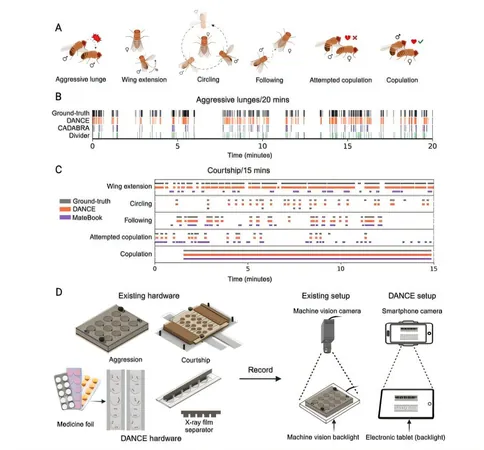
Published in a Reviewed Preprint in eLife, the study introduces the Drosophila Aggression and Courtship Evaluator (DANCE). This open-source software harnesses existing technologies to automate the intricate task of quantifying male social interactions. The research highlights DANCE's ability to deliver precise and reliable behavior classifications, effectively using commonplace laboratory equipment alongside advanced behavior classifiers developed from existing software frameworks.
Drosophila has long been a cornerstone in behavioral neuroscience, with its well-documented social behaviors—ranging from chasing and lunging during confrontations to wing extensions and courtship rituals—providing a rich tapestry for study. While traditional manual assessments are deemed the gold standard, they are often hindered by time constraints and limitations in large-scale studies. Machine learning approaches have emerged to tackle this issue, but they frequently fall short due to high costs and imperfect models.
Lead author Sai Prathap Yadav, a Ph.D. student at the Center for Molecular Neurosciences, emphasized a critical challenge: “Many available software tools for classifying Drosophila social behaviors rely on inflexible rules, leading to inaccuracies in scoring.” Yadav noted that while supervised learning tools exist, access to trained classifiers has been a barrier for many researchers.
DANCE breaks down this barrier by offering freely available automated analysis tools capable of recognizing six distinct fruit fly behaviors. With specific classifiers for aggression, the tool effectively identifies “lunges”—a hallmark aggressive act—more accurately than conventional methods. Meanwhile, classifiers for courtship behaviors, such as wing extensions and copulation attempts, also exhibited reliability comparable to expert manual scoring.
Traditional setups for these experiments often demand costly and complex hardware—necessitating specialized equipment just to conduct basic behavioural assays. In a remarkable innovation, the authors utilized smartphone cameras and simple materials like repurposed medicine blister packs, creating an entire experimental setup for under $0.30—an astonishing difference compared to previous installations costing thousands.
The effectiveness of the new hardware was confirmed by benchmarking against established experimental outcomes, ensuring reliable replication of aggression and courtship behaviors across varying social conditions. Notably, the DANCE tool facilitated groundbreaking discoveries, such as the identification of dopaminergic neuron groups linked to aggression—a finding not previously demonstrated.
Senior author Dr. Pavan Agrawal stated, “DANCE presents a robust, user-friendly platform for recording and analyzing fruit fly behavior, offering performance that rivals expensive systems.” He added, “With its adaptability, DANCE holds the potential for broader applications in studying complex behaviors across various insects and could be employed in fields closer to these organisms' natural habitats.
This pioneering tool not only opens the door to accelerated behavioral analysis in resource-limited environments but also sets the stage for new discoveries in neuroscience, enabling a more inclusive global research community. Stay tuned, as the potential applications of DANCE may lead to revolutionary insights in the realm of animal behavior and genetics!
 Brasil (PT)
 Canada (EN)
 Chile (ES)
 Česko (CS)
 대한민국 (KO)
 España (ES)
 France (FR)
 Hong Kong (EN)
 Italia (IT)
 日本 (JA)
 Magyarország (HU)
 Norge (NO)
 Polska (PL)
 Schweiz (DE)
 Singapore (EN)
 Sverige (SV)
 Suomi (FI)
 Türkiye (TR)
 الإمارات العربية المتحدة (AR)