Revolutionizing Breast Cancer Diagnosis: How AI is Transforming the Detection of HER2-Low Expression
2025-04-18
Author: Wei Ling
A Groundbreaking Shift in Breast Cancer Treatment
Breast cancer (BC) remains alarmingly prevalent, being the most common cancer among women globally and the leading cause of cancer-related deaths in 2022. In China alone, it has overtaken all other cancers, contributing to approximately 18% of worldwide BC fatalities. The battle against this disease continues to be a significant health challenge, and innovative strategies are urgently needed.
Understanding HER2: The Game-Changer in Treatment
The human epidermal growth factor receptor 2 (HER2) has been identified as a critical factor in breast cancer prognosis and treatment. Traditionally, only HER2-positive patients could benefit from targeted therapies like trastuzumab, which have significantly improved outcomes for many. However, recent studies indicate a need for an expanded understanding of HER2 status, particularly regarding HER2-low expression—previously classified as HER2-negative.
The AI Advantage: Precision in Diagnosis
With the clinical significance of HER2-low status becoming clearer, accurate identification has never been more crucial. Yet, the current methodology for differentiating HER2 expression levels—from zero to low—has proven inconsistent, often leading to misdiagnoses. Here’s where artificial intelligence (AI) comes into play. AI technologies have emerged as a promising solution, providing rapid and reliable diagnosis from hematoxylin–eosin (HE) stained slides. By harnessing deep learning algorithms, researchers can now assess HER2 expression with greater accuracy, offering hope for improved patient outcomes.
Bridging the Gap: The Study's Insights
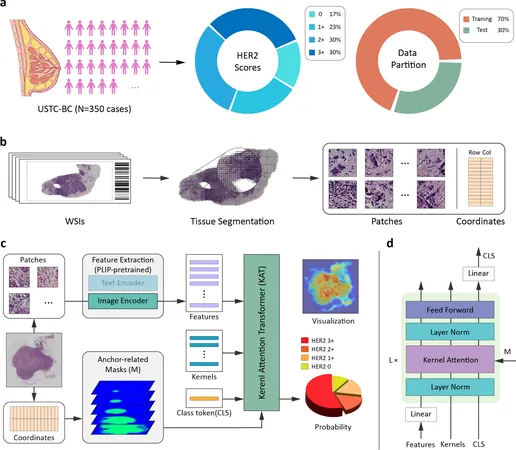
A recent study leveraged AI to analyze a cohort of BC cases, aiming to enhance the precision of HER2 status determination. The researchers utilized machine learning techniques, specifically convolutional neural networks (CNN), to predict HER2 expression from HE-stained pathology slides, tapping into vast datasets to train their models.
Comprehensive Data Collection: A Key Step Forward
In their research, the team gathered a diverse range of breast cancer cases, meticulously annotated according to established guidelines. These cases were systematically divided into training and test datasets, ensuring robust validation of the AI model's performance.
Shining a Light on AI Performance
The results were promising, with the AI model demonstrating superior accuracy and reliability in predicting HER2 scores when compared to existing models. This breakthrough not only showcases the potential of AI in clinical pathology but also holds the potential to revolutionize treatment protocols, particularly for patients previously deemed untreatable.
The Road Ahead: Challenges and Future Directions
Despite these advancements, the study acknowledges significant challenges—chief among them, the class imbalance within datasets and the variability in slide preparation and interpretation. As researchers pave the way toward clinical implementation, future work will focus on expanding data sources, refining model accuracy, and ensuring consistency across medical environments.
A New Dawn in Breast Cancer Treatment
As we stand on the brink of a new era in breast cancer diagnosis, the integration of AI technology promises to unlock new avenues for effective therapy, particularly for HER2-low BC patients. This could herald a transformative shift in how we approach treatment, making strides toward better outcomes in breast cancer care.
 Brasil (PT)
 Canada (EN)
 Chile (ES)
 Česko (CS)
 대한민국 (KO)
 España (ES)
 France (FR)
 Hong Kong (EN)
 Italia (IT)
 日本 (JA)
 Magyarország (HU)
 Norge (NO)
 Polska (PL)
 Schweiz (DE)
 Singapore (EN)
 Sverige (SV)
 Suomi (FI)
 Türkiye (TR)
 الإمارات العربية المتحدة (AR)