Revolutionizing Deep Learning: MIT's Napkin-Simple Diagrams Transform Algorithm Optimization
2025-04-24
Author: Ming
Unlocking the Future of Complex Systems
As our world grows increasingly interconnected, managing complex systems—from city transportation networks to efficient robotics—becomes a vital challenge for software engineers. Now, researchers at MIT have unveiled a groundbreaking approach that simplifies these intricate problems through a remarkably simple tool: diagrams that could fit on a napkin!
A Breakthrough Methodology
Described in the journal *Transactions of Machine Learning Research*, this innovative technique is the brainchild of incoming doctoral student Vincent Abbott and Professor Gioele Zardini from MIT's Laboratory for Information and Decision Systems. Zardini explains, "We designed a new language to discuss these complex systems, rooted in category theory." This diagram-based language focuses on optimizing the architecture of computer algorithms—essentially the fundamental instructions that sense and control various system components.
Overcoming Complexity in Optimization
Optimizing such systems poses significant hurdles. Changes in one area often ripple through others, complicating the entire process. The MIT team concentrated on deep-learning algorithms, a hot research topic recognized for powering massive AI models, including ChatGPT and Midjourney, which rely on intricate data manipulations.
Visualizing Deep Learning Efficiency
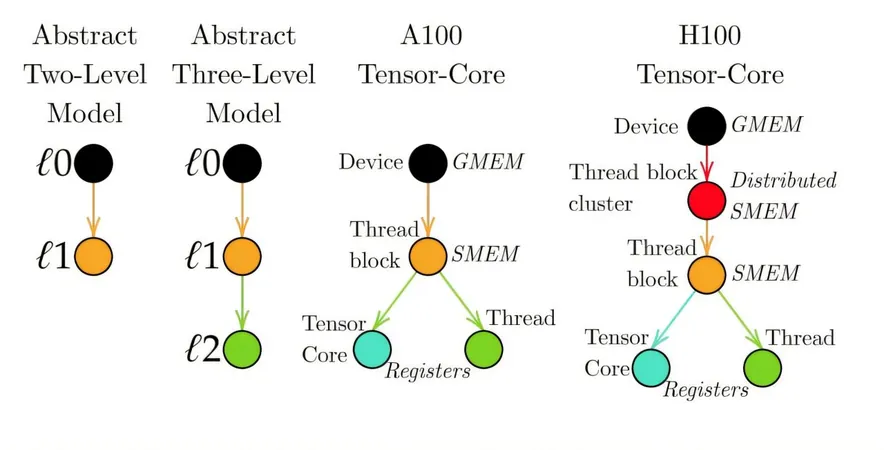
These diagrams facilitate a clear representation of the parallel processes within deep-learning models, illuminating how algorithms interact with the advanced GPU technologies provided by companies like NVIDIA. Zardini expresses excitement over this development, stating, "We’ve found a language that clearly describes deep learning algorithms, emphasizing crucial elements such as energy consumption and memory allocation."
From Months to Minutes: Revolutionizing Algorithm Development
Traditionally, optimizing deep-learning models has required extensive trial and error, often taking years. The renowned FlashAttention optimization alone took over four years to create. However, Zardini asserts, "With our new framework, we can approach these issues far more formally and efficiently, represented visually in our graphical language." This innovation could dramatically reduce the time needed to derive such algorithms.
Harnessing Category Theory for Systematic Insights
Category theory serves as the backbone of this novel approach. It allows researchers to mathematically delineate system components and their interactions, facilitating a deeper understanding of how algorithms operate as mathematical models. Abbott emphasizes that this explicit representation transforms how we can analyze these systems.

 Brasil (PT)
 Canada (EN)
 Chile (ES)
 Česko (CS)
 대한민국 (KO)
 España (ES)
 France (FR)
 Hong Kong (EN)
 Italia (IT)
 日本 (JA)
 Magyarország (HU)
 Norge (NO)
 Polska (PL)
 Schweiz (DE)
 Singapore (EN)
 Sverige (SV)
 Suomi (FI)
 Türkiye (TR)
 الإمارات العربية المتحدة (AR)