Revolutionizing Gravitational Wave Analysis: How Machine Learning is Changing the Game
2025-04-22
Author: John Tan
A Breakthrough in Identifying Cosmic Phenomena
In a groundbreaking study published in *Physical Review Letters*, scientists have unveiled a pioneering approach to deciphering binary systems by harnessing the power of machine learning. Instead of merely relying on individual parameters, this new method delves into the entire posterior distribution, transforming how we analyze gravitational waves.
The Cosmic Ripple Effect
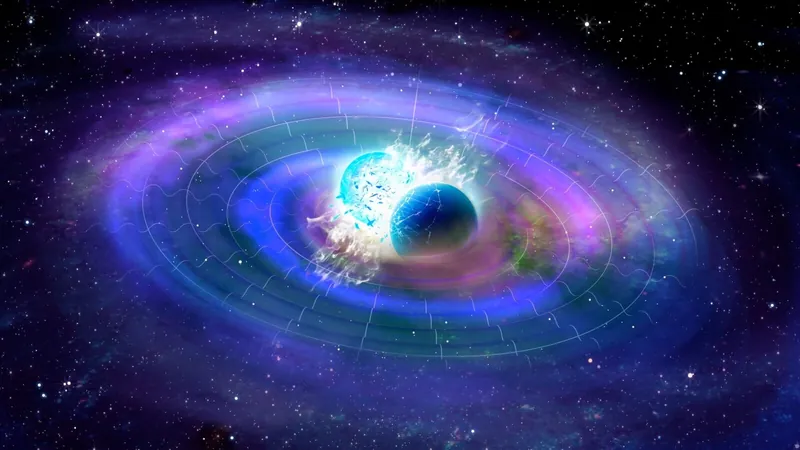
Since their momentous detection in 2015, gravitational waves have captivated astronomers, providing a remarkable avenue to explore the early universe and cosmic events like the merging of compact binary systems. These systems, composed of two colossal objects such as neutron stars or black holes, emit ripples in spacetime—gravitational waves—that reveal critical information about their nature.
The Labeling Dilemma
A significant challenge arises when labeling the components of these binary systems: the heavier object is conventionally marked as "1" and the lighter as "2." However, this standard becomes murky when the masses are nearly identical within the margin of error, causing confusion in data interpretation.
Redefining the Rules with Machine Learning
Researchers addressed this confusion by proposing a holistic approach, discarding the reliance on a single parameter. Dr. Davide Gerosa, lead author from the University of Milano-Bicocca, remarked, "Our research questions long-held assumptions about gravitational wave analyses. We challenged whether the traditional methods were truly the best, and we found that machine learning offers a powerful, data-driven alternative." Together with his students and colleagues, Dr. Gerosa aimed to redefine how we understand black holes.
Innovative Methodology: Constrained Clustering
By framing the challenge as a constrained clustering problem in machine learning, the research team utilized semi-supervised algorithms to discern patterns in the data, ensuring the two objects from each gravitational wave event were distinctly categorized. Instead of fixating on one defining trait, like mass, they allowed the data to guide their differentiation strategy.
Sharper Insights into Spin Measurements
The application of this machine learning model on synthetic and real data from LIGO, Virgo, and KAGRA detectors yielded remarkable results. The precision in black hole spin measurements surged by up to a staggering 50%, allowing scientists to more confidently differentiate between black holes and neutron stars. Dr. Gerosa noted, "This kind of precision could traditionally necessitate new instruments, but we’ve demonstrated that enhanced accuracy is attainable through advanced data analysis techniques."
Shifting Paradigms in Gravitational Wave Events
The findings suggest that around 10% of the posterior samples in LIGO and Virgo data might be better interpreted with different labels. While this may seem a small percentage, the implications are profound. For example, in the gravitational-wave event GW191103_012549, the conventional analysis indicated a 13% chance of one black hole spinning against the orbital motion; this probability dropped to an astonishing 0.1% with the new approach, suggesting that the black hole was likely spinning in sync with its orbit.
Implications for the Future of Astrophysics
Dr. Gerosa emphasized that this analysis could influence measurements from current and future gravitational wave detectors, including upcoming facilities like the Laser Interferometer Space Antenna (LISA) and the Einstein Telescope. This research exemplifies how reevaluating fundamental assumptions in data science can lead to revolutionary insights without needing additional data.

 Brasil (PT)
 Canada (EN)
 Chile (ES)
 Česko (CS)
 대한민국 (KO)
 España (ES)
 France (FR)
 Hong Kong (EN)
 Italia (IT)
 日本 (JA)
 Magyarország (HU)
 Norge (NO)
 Polska (PL)
 Schweiz (DE)
 Singapore (EN)
 Sverige (SV)
 Suomi (FI)
 Türkiye (TR)
 الإمارات العربية المتحدة (AR)