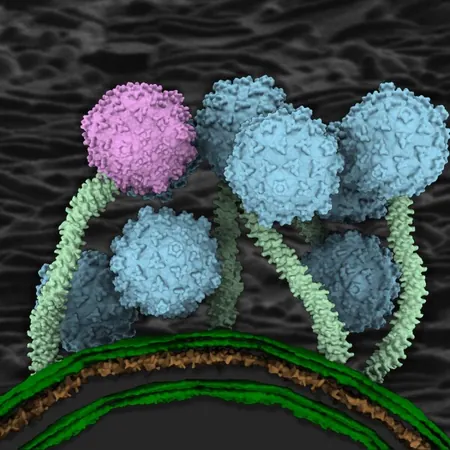
Revolutionizing Tuberculosis Treatment: Insights into the Structure of Mycobacteriophage Bxb1
2025-04-22
Author: Arjun
In a groundbreaking discovery, researchers from Scripps Research and the University of Pittsburgh have illuminated the intricate structure of a virus known as a bacteriophage, specifically Bxb1, which targets Mycobacteria—the deadly culprits behind tuberculosis (TB). With TB causing over a million deaths annually and antibiotic resistance rising, this research is more crucial than ever.
Phage therapy, which utilizes viruses to combat drug-resistant bacteria, is emerging as a promising alternative to conventional antibiotics. Unlike antibiotics, phages have evolved to precisely identify and eradicate specific bacteria. However, much remains unknown about how these phages interact with Mycobacteria.
Peering into the Insides of a Phage: What They Found
Assistant Professor Donghyun Raphael Park from Scripps Research emphasized the importance of understanding phage interactions to leverage them as effective therapies against stubborn infections. The research team employed advanced imaging techniques like single-particle cryo-electron microscopy (cryo-EM) and cryo-electron tomography (cryo-ET) to capture Bxb1 in action during various stages of infection.
The findings were startling: instead of the expected mechanism where phages puncture bacterial membranes to inject their DNA, Bxb1 seemed to follow a different pathway, suggesting a unique method of genome entry against Mycobacteria's notoriously thick cell walls.
Decoding the Mystery of Mycobacteriophages
As Park noted, understanding the structure of just one mycobacteriophage could pave the way to understanding thousands of others. Their key observation lies in the phage’s tail tip, which dramatically alters shape when binding to a bacterial cell, hinting at a sophisticated mechanism of infection.
The research team's endeavors could be pivotal in identifying what characteristics make a phage effective, thus aiding in the design of targeted therapies against antibiotic-resistant TB.
The Road Ahead: Targeting Tough Bacteria
While Park’s lab won’t be able to investigate every mycobacteriophage out there, they plan to focus on a select few that hold promise for linking structural features to functional capabilities. This targeted approach is critical in forming a strategic arsenal against Mycobacteria, potentially leading to breakthroughs in phage therapy.
This innovative research—"Structure and infection dynamics of mycobacteriophage Bxb1"—not only sheds light on the battle against TB but also paves the way for future medical advancements in overcoming antibiotic resistance.
The study featured contributions from multiple researchers, including Professor Graham Hatfull and other notable scientists, signaling a collaborative effort to unveil secrets in the fight against one of the world's most lethal diseases.
 Brasil (PT)
 Canada (EN)
 Chile (ES)
 Česko (CS)
 대한민국 (KO)
 España (ES)
 France (FR)
 Hong Kong (EN)
 Italia (IT)
 日本 (JA)
 Magyarország (HU)
 Norge (NO)
 Polska (PL)
 Schweiz (DE)
 Singapore (EN)
 Sverige (SV)
 Suomi (FI)
 Türkiye (TR)
 الإمارات العربية المتحدة (AR)