Scientists Achieve Groundbreaking Synthesis of Livermorium, Paving the Way for Element 120!
2025-04-07
Author: Li
In an astounding achievement, physicists at the Lawrence Berkeley National Laboratory have made history by successfully creating two atoms of livermorium (Lv), the elusive element 116. This groundbreaking feat was accomplished using a titanium beam in their state-of-the-art 88-Inch Cyclotron, marking the first time this element has been produced via this innovative method.
With only 118 known elements in the periodic table—of which 90 occur naturally on Earth—the quest for synthesizing heavier elements continues to challenge scientists worldwide. Elements beyond fermium, which has 100 protons, require combining the nuclei of lighter elements, but not every combination yields success. Historically, the heaviest elements were synthesized using a method that involved fusing a specific isotope of calcium, calcium-48, with heavier elements, a process which only worked up to element 118 (oganesson).
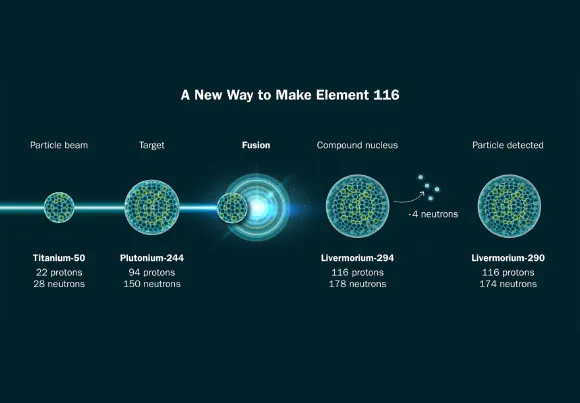
However, Dr. Jacklyn Gates and her esteemed team have initiated a new frontier by experimenting with titanium-50—a stable isotope with 22 protons and 28 neutrons. By fusing this with plutonium-244, containing 94 protons and 150 neutrons, they accomplished the synthesis of livermorium over the course of 22 painstaking days. This groundbreaking method not only confirms the potential for creating new elements but also suggests that scientists at Berkeley Lab may be able to push beyond oganesson towards element 120!
The synthesis of element 120 promises to be a monumental challenge, expected to be ten to twenty times more difficult than creating livermorium. If successful, element 120 would reign as the heaviest known element, offering scientists unparalleled opportunities to explore the outer boundaries of atomic structure and test existing nuclear physics theories.
“This reaction had never been demonstrated before, and it was essential to prove it was possible before embarking on our attempt to make 120,” Dr. Gates expressed, reflecting on the significance of this breakthrough. Dr. Jennifer Pore, also from Lawrence Berkeley National Laboratory, emphasized that the transition from using a calcium beam to a titanium beam could change the rate at which these complex elements are produced, providing a clearer understanding of the mechanics at play.
“We are standing at the absolute edge of human knowledge and understanding. There’s no guarantee that physics will work the way we expect,” Pore noted, highlighting the unpredictable nature of this scientific frontier.
The team’s remarkable findings have been documented in the prestigious journal *Physical Review Letters*, ensuring that this vital research contributes to the ongoing quest for knowledge in the field of nuclear science.
Stay tuned as this groundbreaking research unfolds, and witness the incredible journey towards element 120—are we on the precipice of redefining our understanding of the universe’s building blocks? Don’t miss out on the latest updates in this thrilling scientific adventure!
 Brasil (PT)
 Canada (EN)
 Chile (ES)
 Česko (CS)
 대한민국 (KO)
 España (ES)
 France (FR)
 Hong Kong (EN)
 Italia (IT)
 日本 (JA)
 Magyarország (HU)
 Norge (NO)
 Polska (PL)
 Schweiz (DE)
 Singapore (EN)
 Sverige (SV)
 Suomi (FI)
 Türkiye (TR)
 الإمارات العربية المتحدة (AR)