Scientists Achieve Groundbreaking 'Tattooing' of Tardigrades!
2025-04-23
Author: Jia
Meet the Incredible Tardigrade: Nature's Toughest Survivor!
Prepare to be amazed by the seemingly indestructible tardigrade, these minuscule creatures, also known as water bears, are half a millimeter long and boast the unfathomable ability to withstand extreme conditions—from freezing temperatures and starvation to intense radiation and even the vacuum of outer space!
Tattooing Tardigrades: A Scientific Marvel!
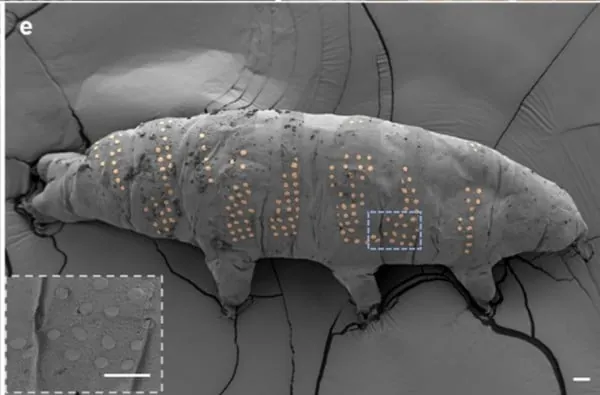
In an incredible twist, researchers from ACS’ Nano Letters have harnessed the resilient nature of tardigrades to create tiny 'tattoos.' This revolutionary step aims to test a groundbreaking microfabrication technique that could propel advancements in biomedical engineering and medicine!
"We're not just tattooing tardigrades; we're expanding this technology to other living organisms!" explains co-author Ding Zhao.
How Did They Do It?
Utilizing a technique known as ice lithography, scientists coated the tardigrades in a thin layer of ice and carved intricate designs using an electron beam. Why tardigrades? Their unique capability to survive extreme cold makes them the perfect subjects for this cutting-edge experiment.
The process involves placing the dehydrated tardigrades onto carbon-composite paper chilled to below -226°F (-143°C), then protecting them with a layer of anisole, a compound with an alluring anise scent. As the electron beam does its work, the anisole transforms into a biocompatible compound that adheres to the water bear’s surface!
A Variety of Patterns & High Survival Rates!
The researchers successfully created a range of micropatterns, including squares, dots, and even their university logo, with features as tiny as 72 nanometers wide. Impressively, around 40% of the tardigrades survived the process—potentially a figure that could improve further with refinement.
What’s Next? The Future of Biomedical Engineering!
Upon revival, these tattooed tardigrades exhibited no behavioral changes, indicating that this tattooing method could pave the way for printing microelectronics and sensors onto living tissues.
Gavin King, credited with innovating ice lithography, emphasizes the significance of this advancement, hinting at an era where biomaterial devices and sensors inspire futuristic realities previously imagined only in science fiction.
The Journey Ahead!
As researchers Zhao and Qiu look ahead, their work could lead to exciting innovations such as microbial cyborgs and other biomedical applications. The future of science just got a powerful dose of resilience and fluorescence with this remarkable revelation!


 Brasil (PT)
 Canada (EN)
 Chile (ES)
 Česko (CS)
 대한민국 (KO)
 España (ES)
 France (FR)
 Hong Kong (EN)
 Italia (IT)
 日本 (JA)
 Magyarország (HU)
 Norge (NO)
 Polska (PL)
 Schweiz (DE)
 Singapore (EN)
 Sverige (SV)
 Suomi (FI)
 Türkiye (TR)
 الإمارات العربية المتحدة (AR)