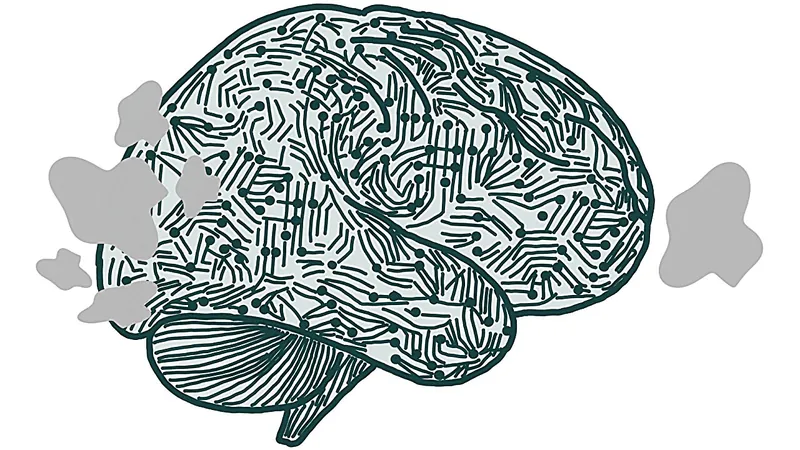
Seeing with Purpose: How Our Visual Cortex Adapts to Our Goals
2025-04-19
Author: Arjun
When you spot a bag of carrots at the grocery store, your thoughts might leap to different possibilities: are you envisioning a warm winter stew or gearing up for a Super Bowl feast with snacks?
Surprisingly, the way you categorize that carrot—whether as a staple vegetable or a party treat—depends on your specific goals. Traditionally, scientists believed that the prefrontal cortex handled this job, processing visual data like a security camera. However, a groundbreaking new study suggests that our visual cortex is much more dynamic.
Conducted by Nuttida Rungratsameetaweemana, a biomedical engineer and neuroscientist at Columbia Engineering, this research, recently published in <em>Nature Communications</em>, reveals that our brain's visual areas actively interpret information based on our immediate needs and objectives. For instance, when it's game day, your visual cortex identifies those carrots as essential snacks before the prefrontal cortex even registers their presence.
What makes this study particularly fascinating is its challenge to the conventional view. Rungratsameetaweemana states, 'Our findings show that the visual system doesn't just record what we see; it actively reshapes how we understand objects based on what we aim to do. This opens up new possibilities for creating adaptive AI systems that can reflect this brain flexibility.'
So how did researchers uncover this exciting insight? In previous studies, most focus was laid on long-term learning, but this one zoomed in on the brain's rapid adaptability. Using functional magnetic resonance imaging (fMRI), they tracked brain activity while participants categorized shapes under ever-changing rules.
They utilized advanced computational tools to analyze the patterns of brain activation connected to how participants sorted these shapes. The results were telling: the visual cortex adjusted its activity based on the categorization rules, especially when participants encountered ambiguous shapes that were tougher to differentiate.
What emerging conclusions did they draw? The data revealed that the early visual system—responsible for immediate visual input—was continually adapting, enhancing its processing abilities in real-time, especially when precision mattered most.
This discovery holds significant implications. While human cognition thrives on flexibility, current AI systems fall short in adapting to new tasks. The findings could inform the design of more versatile AI, as well as provide insights into cognitive flexibility issues present in disorders like ADHD.
What lies ahead for this research? The team aims to dig deeper into how flexible coding operates at the level of neural circuits. Following their fMRI observations, they plan to record neurological activity directly within the skull, offering a closer look at how individual neurons support adaptable, goal-directed behavior.
In a world where adaptability is crucial, understanding how our brains fine-tune perception could eventually lead not only to robust AI systems but also to deeper insights into cognitive health.

 Brasil (PT)
 Canada (EN)
 Chile (ES)
 Česko (CS)
 대한민국 (KO)
 España (ES)
 France (FR)
 Hong Kong (EN)
 Italia (IT)
 日本 (JA)
 Magyarország (HU)
 Norge (NO)
 Polska (PL)
 Schweiz (DE)
 Singapore (EN)
 Sverige (SV)
 Suomi (FI)
 Türkiye (TR)
 الإمارات العربية المتحدة (AR)