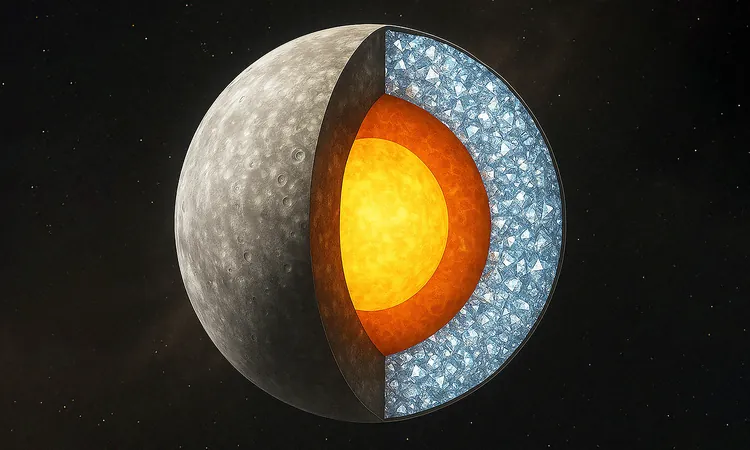
Shocking Discovery: Mercury's Hidden 10-Mile-Thick Diamond Layer Revealed!
2025-04-19
Author: Nur
Mercury's Hidden Gem: 10 Miles of Diamonds Beneath the Surface!
Planet Mercury, often overlooked as a blistering wasteland, has unveiled an astonishing secret! Researchers now suggest that beneath its harsh surface lies a staggering layer of diamond approximately 10 miles thick.
Imagine a planet that rotates thrice for every two trips around the sun while scorching under temperatures exceeding 800 °F – and now, the prospect of buried diamonds adds an electrifying twist to its tale.
Uncovering Carbon Riches: NASA's Insight
The plot thickened when NASA's MESSENGER spacecraft uncovered intriguing hints of carbon wealth on Mercury's surface. Patches of graphite hinted at an ancient magma ocean, rich with carbon that formed during the planet’s fiery past.
As this ocean cooled, lighter carbon floated to the surface, while heavier metals sank. New research posits that the heavier carbon crystallized into diamond as it descended, rewriting our understanding of how Mercury evolved.
Laboratory Marvel: Recreating Mercury's Conditions
Led by Dr. Yanhao Lin from a collaborative team in China and Belgium, researchers mimicked Mercury's extreme conditions in a high-pressure lab. By compressing synthetic mantle rock and heating it to nearly 3,600 °F, they discovered that under such immense pressure, carbon transforms from graphite to diamond at the core-mantle boundary.
This process, involving the addition of sulfur, plays a crucial role in forming a diamond shell around Mercury's metallic core.
Why Diamonds Matter for Mercury's Magnetic Field
Perhaps even more intriguing, the presence of diamonds could explain Mercury's surprisingly potent magnetic field. The diamond's exceptional thermal conductivity allows it to funnel energy efficiently from the core to the mantle, influencing heat distribution and potentially affecting how the magnetic field operates.
A Unique Chemical Fingerprint of Mercury
Mercury's rich carbon history sets it apart from Earth, Mars, and Venus, which lost much of their carbon content over time. This planet appears to store carbon in both graphite and diamond forms, hinting at unique geological processes that could be mirrored in other rocky worlds in our solar system.
The Quest for More Knowledge: What's Next?
While this groundbreaking discovery is rooted in laboratory experiments, the journey is far from over. The BepiColombo spacecraft, set to reach Mercury in 2030, will provide critical data, including precise gravity maps and magnetic field analyses, that may confirm the existence of this diamond layer.
Future explorations may even turn to carbon-rich metallic asteroids, pondering whether they, too, could hide similar treasures beneath their surfaces.
Why Should We Care?
This isn't just about the allure of precious stones; it's a window into planetary evolution. Understanding carbon’s transformations helps us comprehend the dynamics of other celestial bodies and may influence our views on how planets, even distant ones, evolve.
Mercury, once dismissed as a mere hot rock, proves that our universe holds mysteries with implications that reach far beyond mere aesthetics—it's a reminder of the hidden complexities that lie within our solar system.
Stay tuned as we await more astonishing revelations from Mercury’s depths!

 Brasil (PT)
 Canada (EN)
 Chile (ES)
 Česko (CS)
 대한민국 (KO)
 España (ES)
 France (FR)
 Hong Kong (EN)
 Italia (IT)
 日本 (JA)
 Magyarország (HU)
 Norge (NO)
 Polska (PL)
 Schweiz (DE)
 Singapore (EN)
 Sverige (SV)
 Suomi (FI)
 Türkiye (TR)
 الإمارات العربية المتحدة (AR)