Shocking Study Reveals Earthquakes Can Conceal Nuclear Test Explosions!
2025-04-24
Author: Wei Ling
Imagine this: an underground nuclear test is conducted, yet the seismic waves generated by a nearby earthquake completely mask it. A startling new study suggests this scenario is not only possible but may happen more frequently than previously thought.
Published in the Bulletin of the Seismological Society of America, researchers from Los Alamos National Laboratory, led by Joshua Carmichael, have unearthed critical findings that challenge long-held beliefs about how natural and man-made seismic events interact.
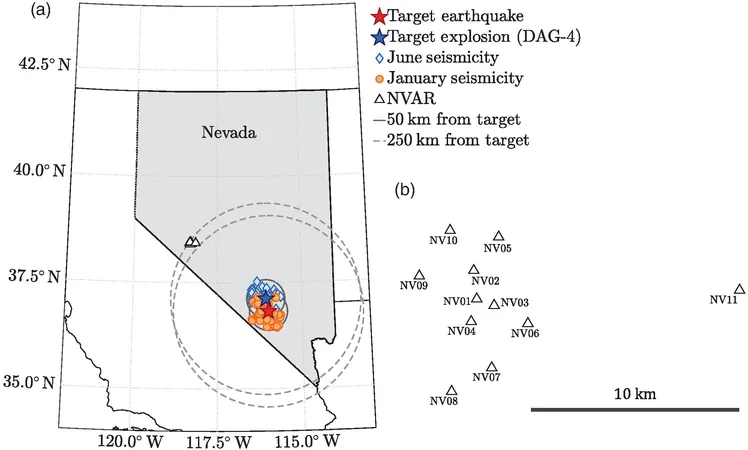
Using cutting-edge detection technology that typically achieves a 97% success rate in identifying a 1.7-ton explosion, researchers found that this rate plummets to just 37% when an earthquake occurs within 100 seconds and about 250 kilometers away.
Carmichael explains, "The overlapping waveforms from an explosion and an earthquake obscure even our most sensitive digital signal detectors, making it nearly impossible to pinpoint the explosion's origin." This revelation raises urgent questions about the reliability of global nuclear test monitoring.
Especially concerning is the situation in North Korea, which has conducted six nuclear tests over the last two decades. The data indicates more low-magnitude seismic activity around these test sites than experts previously acknowledged, hinting that hidden explosions could pose a significant risk.
The team also explored how overlapping signals from earthquake swarms could dramatically reduce detection rates—from an impressive 92% down to a mere 16%. Carmichael warns, "We might be vastly underestimating minor seismic events sourced from swarms or aftershocks, meaning there could be many more earthquakes occurring than we think."
Testing the phenomenon of explosion masking has been problematic due to the rarity of available data on simultaneous explosions and natural seismic activity. However, the researchers devised a novel approach, scaling down explosion data to simulate smaller events, then injecting these signals into earthquake data to determine if they could still be detected.
While researchers typically use multiple methods to monitor nuclear tests—including looking for specific radionuclides in the atmosphere—this study underscores the complexity of ensuring safety and transparency in nuclear monitoring. It may not be easy for an earthquake to completely hide an explosion, but the implications of this study are profound.
Carmichael concludes that this research provides a vital framework for understanding the probability of detecting explosions amid natural seismicity, emphasizing the need for comprehensive monitoring strategies moving forward.
 Brasil (PT)
 Canada (EN)
 Chile (ES)
 Česko (CS)
 대한민국 (KO)
 España (ES)
 France (FR)
 Hong Kong (EN)
 Italia (IT)
 日本 (JA)
 Magyarország (HU)
 Norge (NO)
 Polska (PL)
 Schweiz (DE)
 Singapore (EN)
 Sverige (SV)
 Suomi (FI)
 Türkiye (TR)
 الإمارات العربية المتحدة (AR)