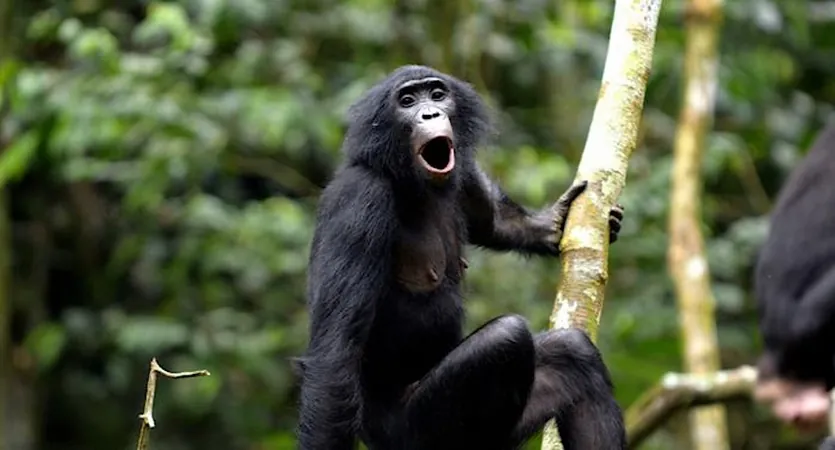
Stunning Discovery: Bonobos Use Complex Language Structures, Just Like Humans!
2025-04-20
Author: Li
Bonobos: Our Closest Relatives with Surprising Communication Skills
In a groundbreaking study, researchers have revealed that bonobos—our closest living relatives—create intricate and meaningful combinations of vocalizations that resemble human language. This astonishing finding challenges the long-standing belief that complex communication is unique to humans.
A Study That Redefines Animal Communication
Conducted by a collaborative team from Harvard and the University of Zurich, the research focused on the vocal behaviors of wild bonobos living in the Kokolopori Community Reserve in the Democratic Republic of Congo. The scientists employed innovative linguistic methods to demonstrate that bonobo communication shares remarkable similarities with human language, particularly in its reliance on ‘compositionality.’
Understanding Compositionality: The Key to Communication
Compositionality refers to the ability to assemble meaningful words into phrases where the overall meaning is tied to both the individual words and their arrangement. To illustrate, in simpler terms, a phrase like "blond dancer" straightforwardly refers to someone who is both blond and dances. However, more complex phrases, such as "bad dancer," convey meanings in which one part modifies the other without retaining an independent meaning.
Creating a Bonobo Dictionary: A Language Breakthrough
As part of their study, the researchers developed what can be described as a bonobo dictionary—a comprehensive list of bonobo calls and their meanings. Lead researcher Mélissa Berthet highlighted that this represents a monumental leap in understanding not just bonobos, but animal communication as a whole.
From Single Calls to Meaningful Combinations
Once they deciphered the meanings of individual bonobo vocalizations, the researchers explored how these calls could be combined, borrowing techniques from human linguistics. Professor Simon Townsend noted that they found multiple combinations that echoed complex structures present in human language. This revelation suggests that the capacity for intricate vocal combinations is less exclusive to humans than previously believed.
Rethinking Evolution: Language Roots in Our Ancestors
This revolutionary research raises questions about the evolutionary origins of language. According to co-author Martin Surbeck, who is a Harvard professor, humans and bonobos diverged from a common ancestor approximately 7 to 13 million years ago, leading both species to inherit characteristics like compositionality.
Implications That Rewrite the Story of Human Communication
These findings imply that the ability to craft complex meanings from vocal elements likely existed long before modern human language began. In essence, bonobo vocal communication is more closely related to human language than we ever imagined. Townsend summed it up brilliantly: our ancestors were using sophisticated compositionality at least 7 million years ago, if not earlier.
A New Era for Animal Language Studies
This study not only elevates our understanding of bonobos but also invites us to reconsider the foundations of human language. As we dive deeper into the complexities of animal communication, who knows what other surprising similarities might emerge?

 Brasil (PT)
 Canada (EN)
 Chile (ES)
 Česko (CS)
 대한민국 (KO)
 España (ES)
 France (FR)
 Hong Kong (EN)
 Italia (IT)
 日本 (JA)
 Magyarország (HU)
 Norge (NO)
 Polska (PL)
 Schweiz (DE)
 Singapore (EN)
 Sverige (SV)
 Suomi (FI)
 Türkiye (TR)
 الإمارات العربية المتحدة (AR)