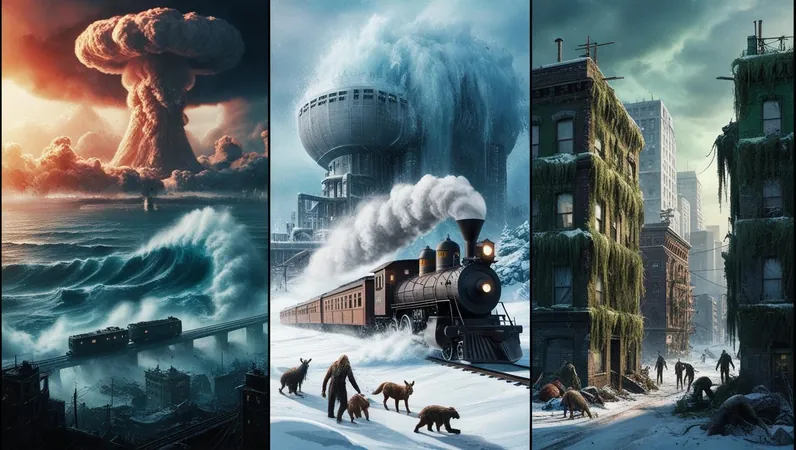
The Dystopian Climate Warning: What TV Reveals About Our Future
2025-04-21
Author: Siti
Art as a Reflection of Reality
Art has always held a mirror to society, revealing hidden truths and sparking crucial discussions. Science fiction and dystopian dramas have a unique ability to transform real-world crises—especially climate change—into compelling narratives that are easier to grasp.
Creativity Meets Urgency
On this World Creativity and Innovation Day, it’s vital to explore how entertainment molds public perception and drives action, using fictional tales to bring us closer to the pressing realities of our warming planet.
Cautionary Tales Amidst Anxiety
Some might avoid these shows due to the risk of spiraling into existential dread over climate disasters. However, these narratives are designed not just to provoke anxiety but to act as cautionary tales. They highlight our world's inadequacies, urging necessary changes before it’s too late. If characters in these fictional worlds can find hope and resilience amid disaster, surely we can too.
The Hopeful Hybrids of "Sweet Tooth"
In Netflix’s "Sweet Tooth," humanity grapples with a deadly virus while hybrid children—part human, part animal—appear as a beacon of hope. Gus, a half-deer child, embodies innocence and wonder. Although feared by adults, who view them as unnatural, these hybrids symbolize a vital connection between humanity and nature.
Amanda Burrell, the show’s executive producer, cites young climate activists as inspiration, emphasizing their clarity of purpose and commitment to a sustainable future. The hybrids challenge the oppressive "Last Men," who seek to restore a patriarchal society, ultimately representing a shift towards empathy and coexistence.
Survival Under Siege: Hulu's "Paradise"
Originally marketed as a political thriller, Hulu's "Paradise" reveals a post-apocalyptic society living under a mountain after civilization collapses. As environmental disasters unravel, from melting ice caps to catastrophic nuclear wars, the series starkly illustrates how quickly our world could descend into chaos.
In this dystopia, the fortunate escape to Paradise, a subterranean utopia built on the sacrifices of marginalized communities exposed to toxic conditions. This reflection of environmental racism reveals how the most vulnerable bear the brunt of climate destruction.
Icebound Realities of "Snowpiercer"
In contrast, TNT’s "Snowpiercer" explores a future where a failed climate intervention has frozen Earth into an inhospitable wasteland. Humanity’s last remnants exist on a moving train, a microcosm of the class divisions that contributed to the apocalypse.
As desperate survivors onboard struggle for survival, the show critiques the short-sighted actions taken to combat climate change. However, hope persists as the marginalized unite to challenge their oppressive structures, illustrating the power of collective resilience.
Nature's Rebellion in "The Last of Us"
In HBO Max's "The Last of Us," climate change directly sparks a devastating fungal pandemic. Following Joel and Ellie as they navigate a post-apocalyptic America, the show underlines that climate change poses an ever-present threat. A pivotal scene hints at how slight temperature increases can lead to startling consequences, reinforcing the need for action.
Despite the chaos, the series showcases thriving communities that sustainably adapt, highlighting nature’s resilience as urban landscapes begin to heal.
Seizing the Future Through Change
While these series depict grim futures, they carry a powerful message: survival is not only possible but requires transformation. We need not wait for crisis to act; we can use these narratives as sparks for change.
As Earth Day 2025 nears, let's rethink our relationship with the planet. Join the movement to foster community resilience and healing. The fate of our world rests in our hands, and these shows serve not just as entertainment but as urgent calls to rewrite our future. What role will you play in this story?
 Brasil (PT)
 Canada (EN)
 Chile (ES)
 Česko (CS)
 대한민국 (KO)
 España (ES)
 France (FR)
 Hong Kong (EN)
 Italia (IT)
 日本 (JA)
 Magyarország (HU)
 Norge (NO)
 Polska (PL)
 Schweiz (DE)
 Singapore (EN)
 Sverige (SV)
 Suomi (FI)
 Türkiye (TR)
 الإمارات العربية المتحدة (AR)