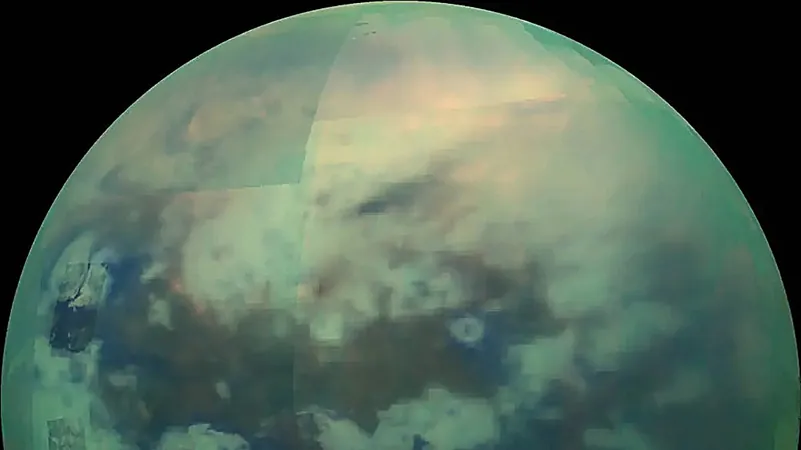
The Enigmatic Case of Titan's Missing Deltas: A Geological Puzzle
2025-04-18
Author: Li
Unlocking Titan's Geological Secrets
When probing the geological history of celestial bodies, river deltas are the ultimate goldmine. These natural formations trap sediment from extensive areas, offering insights into climate, tectonic activity, and even signs of past life. This is one reason NASA deployed its latest Mars rover to Jezero Crater, a site rich with a well-preserved delta.
Now, planetary scientists are turning their gaze toward Titan, Saturn’s fascinating moon, which is the only place besides Earth known to have flowing liquids on its surface. With vast rivers of liquid methane and ethane, one might expect Titan's deltas to be a treasure trove for scientific exploration.
The Disappearing Deltas: A Scientific Mystery
However, a new study reveals an astonishing twist: Titan seems to lack these crucial deltas entirely. Sam Birch, an assistant professor at Brown University and the study's lead author, expressed his disappointment, stating, "Deltas should preserve so much of Titan's history." As they dig deeper into this mystery, a plethora of new questions emerge.
Birch notes, "We assume that rivers and sediments lead to deltas, but Titan defies expectations. It offers a unique playground for analyzing geological processes that we thought we understood."
Titan's Earth-like Features and Fluid Dynamics
As Saturn's largest moon, Titan boasts a thick atmosphere of nitrogen and methane, creating Earth-like weather phenomena such as clouds, winds, and rainfall—albeit with methane instead of water. The landmark discovery of Titan’s liquid bodies came in 2006, thanks to the Cassini spacecraft. Its synthetic aperture radar (SAR) mapped Titan’s surface, revealing expansive channels and large flat areas, suggesting the presence of vast liquid reserves.
Cassini’s Data: What It Missed
Yet a puzzling absence in Cassini’s findings was the lack of visible deltas, even at the mouths of large rivers. Scientists questioned whether they were genuinely absent or just undetectable in the obtained data. To tackle this, Birch's team developed a numerical model, simulating what Cassini’s SAR would detect in landscapes familiar to us—specifically, Earth.
By replacing Earth's water with Titan's methane, they created synthetic SAR images to better interpret Titan's terrain. Their Earth-based simulations successfully showcased large deltas, providing a baseline for comparison.
The Surprising Facts About Titan's Rivers
After applying their model to Titan, the researchers found only two probable deltas near the moon's south pole. A mere 1.3% of Titan's significant rivers terminating at coastlines managed to form deltas, starkly contrasting Earth, where nearly all similar rivers do.
What Could Be Causing This Anomaly?
The reason behind Titan's delta deficit remains elusive. Birch suggests that the physical properties of Titan’s methane rivers should allow sediment transport. However, rapid sea-level fluctuations might disperse deltas across the landscape too quickly for them to coalesce in one spot. Furthermore, winds and tidal forces could also disrupt delta formation, adding to the enigma.
New Mysteries on Titan's Surface
But the absence of deltas isn't the only puzzle presented by this research. Fresh analysis revealed mysterious pits in Titan’s lakes and seas, as well as deep channels on the sea floors—likely carved by river flows—whose origins are unclear.
These revelations call for extensive further study to unravel the secrets hidden on Titan. Birch concluded, "This is really not what we expected. Titan continuously surprises us, which is part of what makes it such an exciting place to investigate."
 Brasil (PT)
 Canada (EN)
 Chile (ES)
 Česko (CS)
 대한민국 (KO)
 España (ES)
 France (FR)
 Hong Kong (EN)
 Italia (IT)
 日本 (JA)
 Magyarország (HU)
 Norge (NO)
 Polska (PL)
 Schweiz (DE)
 Singapore (EN)
 Sverige (SV)
 Suomi (FI)
 Türkiye (TR)
 الإمارات العربية المتحدة (AR)