The Hidden Dangers of Late Motherhood: What Every Woman Needs to Know!
2025-04-25
Author: Wei Ling
Are Women Delaying Motherhood, and At What Cost?
In the past three decades, an alarming trend has emerged: women globally are increasingly postponing childbirth. This shift is driven by several factors, including higher education levels, career priorities, and advancements in reproductive technologies that allow pregnancies at later ages. Notably, a significant rise in births among women over 35 has been observed, despite the well-known decline in fertility that accompanies age.
Eye-Opening Statistics: The Shift at Chiang Mai University Hospital
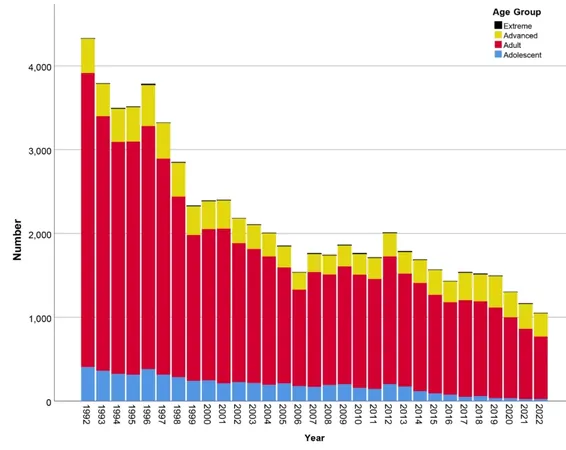
At Chiang Mai University Hospital, the percentage of births to women aged 35 and older skyrocketed from 9.5% in 1992 to a staggering 26.2% in 2022. Yet, a closer look at mothers aged 45 and above reveals a constant rate of just 0.2%. This disparity indicates cultural differences in childbearing ages, with Western women tending to conceive later than their Asian counterparts.
The Risks of Late Motherhood: What You Need to Know
Pregnancy at an advanced age comes with heightened risks, including complications like miscarriage, preterm birth, low birth weight, and greater chances of stillbirth. As women age, their bodies face significant physiological changes that complicate pregnancy. Chronic health issues also become more prevalent, adding another layer of risk.
What the Numbers Reveal: A Comprehensive Study
A recent retrospective cohort study evaluated 67,301 pregnancies at Chiang Mai University, providing crucial insight into outcomes for mothers of different age groups. This research found that women aged 45 and above faced a 11-fold higher risk of miscarriage and a striking 9.1% prevalence of fetal trisomy, in stark contrast to just 0.1% in younger mothers.
The Ugly Truth About Adverse Outcomes
The study illuminated that pregnancies at 45 and older more often resulted in lower gestational ages at birth (averaging just 35.8 weeks) and a significant rise in preterm births, hitting an alarming rate of 39.6%. Moreover, these mothers recorded a 41.2% incidence of low birth weight babies compared to just 14.5% in younger controls.
A Call to Action: Don't Gamble with Your Health!
The findings suggest a pressing need for women considering late motherhood to consult with healthcare professionals ahead of time. Preconception counseling and early prenatal care can help anticipate and manage the risks associated with pregnancies in advanced maternal ages.
Conclusion: The Stakes Are High!
As research highlights, pregnancy outcomes worsen as women approach the end of their reproductive years. With serious risks such as fetal trisomy and a host of complications, it's crucial for women to seek guidance and understand the implications of delaying motherhood. Future studies should emphasize this critical information to empower women making reproductive choices.
 Brasil (PT)
 Canada (EN)
 Chile (ES)
 Česko (CS)
 대한민국 (KO)
 España (ES)
 France (FR)
 Hong Kong (EN)
 Italia (IT)
 日本 (JA)
 Magyarország (HU)
 Norge (NO)
 Polska (PL)
 Schweiz (DE)
 Singapore (EN)
 Sverige (SV)
 Suomi (FI)
 Türkiye (TR)
 الإمارات العربية المتحدة (AR)