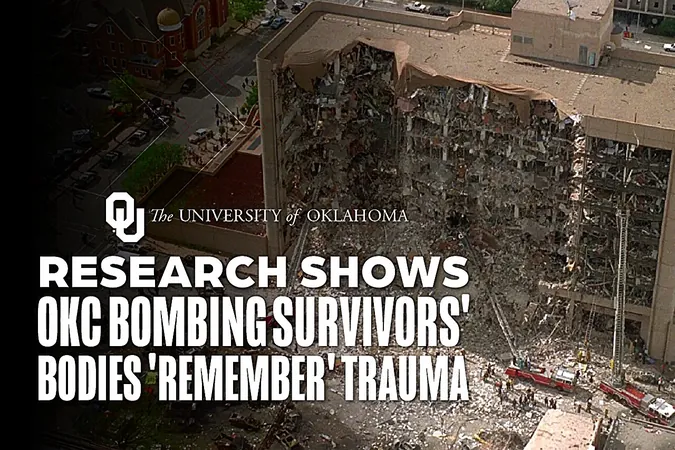
The Hidden Legacy of Trauma: How the Oklahoma City Bombing Still Affects Survivors' Bodies
2025-04-10
Author: Nur
New Study Reveals Lasting Impact of Trauma on Oklahoma City Bombing Survivors
A groundbreaking study from the University of Oklahoma has unveiled a striking revelation: survivors of the 1995 Oklahoma City bombing carry lingering physiological traces of their trauma, even as they lead healthy and resilient lives. Their bodies seem to "remember" the horror, independent of any visible physical or mental health issues.
Exploring Biological Markers of Stress
While several studies have focused on the psychological and biological effects of trauma in victims of terrorism, this research published in Prehospital and Disaster Medicine stands out by examining three distinct biological systems in physically healthy survivors. The research explored cortisol levels—crucial to stress responses—and measured changes in heart rate, blood pressure, and interleukins, which are key inflammatory substances that affect the immune system.
Surprising Findings: Lower Cortisol but Higher Blood Pressure
The research included 60 direct survivors, contrasting their responses with a control group of local individuals unaffected by the bombing. Surprisingly, results showed that cortisol levels were lower in survivors, while their blood pressure spiked and heart rates remained deliberately subdued in the face of trauma cues. This suggests that their physiological reactions may have dulled over time.
A Deeper Dive into Inflammation
Two interleukins were analyzed during the study: interleukin 1B, associated with inflammation, was notably elevated among survivors, while interleukin 2R, which typically offers protection, was found at lower levels. As Dr. Phebe Tucker, lead author and a key psychiatrist, remarked, "The main takeaway is that while the mind can be resilient, the body doesn’t forget—and it remains on high alert for future stressors."
Mismatch Between Physical and Emotional Responses
Interestingly, the expected correlation between these biological markers and psychological symptoms like PTSD and depression was absent. Survivors reported no heightened emotional distress, which poses questions about the silent stress responses taking place within their bodies.
Long-Term Health Implications
Dr. Tucker highlighted potential concerns, noting that elevated interleukin 1B is usually indicative of inflammation and illness, yet the participants were generally healthy. "The findings raise red flags about their long-term health," she cautioned, emphasizing the need for further research.
Unlocking the Mysteries of Trauma's Aftermath
This new study builds on previous investigations into bombing survivors, marking a significant progression in the understanding of trauma’s durability. Co-author Dr. Rachel Zettl noted, "After severe trauma, your biological systems might no longer operate at a normal baseline; everything has shifted." She insisted, "It’s clear: it’s not just our minds that carry the weight of trauma—our bodies do too. This alters our very physical being." With contributions from notable experts in the field, the study opens up a dialogue about the unseen ramifications of trauma—long after the event has passed—and underscores the need for continued examination of survivors' health.

 Brasil (PT)
 Canada (EN)
 Chile (ES)
 Česko (CS)
 대한민국 (KO)
 España (ES)
 France (FR)
 Hong Kong (EN)
 Italia (IT)
 日本 (JA)
 Magyarország (HU)
 Norge (NO)
 Polska (PL)
 Schweiz (DE)
 Singapore (EN)
 Sverige (SV)
 Suomi (FI)
 Türkiye (TR)
 الإمارات العربية المتحدة (AR)