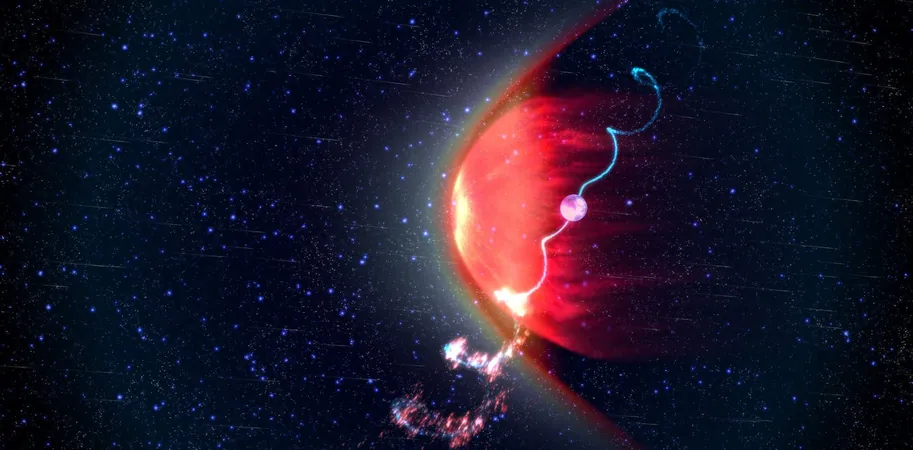
Twinkling Star Unveils Shocking Secrets of Cosmic Plasma
2025-04-21
Author: Li
A Cosmic Discovery Like No Other
With the southern hemisphere's most powerful radio telescope, astronomers have observed a twinkling star, unlocking a treasure trove of mysterious plasma structures in our cosmic backyard.
These plasma formations, akin to interstellar cyclones stirred by energetic galactic events, reveal a chaotic and turbulent interstellar medium teeming with secrets about the universe.
A Deep Dive into Pulsars and Their Shock Waves
The groundbreaking study, published in *Nature Astronomy*, provides unparalleled insights, including the first measurements of plasma layers within an interstellar shock wave surrounding a pulsar. Our newfound understanding shows that the local interstellar medium is packed with these intriguing structures, challenging existing theories of pulsar shock waves.
Focusing on the nearby pulsar J0437-4715, located just 512 light-years away from Earth, researchers shed light on this fast-spinning neutron star renowned for emitting beams of radio waves and a powerful energetic wind of particles.
The Fascinating Science of Twinkling Stars
As this pulsar moves at supersonic speeds through the cold gas, dust, and plasma of the interstellar medium, it creates a bow shock—a visible shock wave of heated gas glowing red.
The turbulent nature of interstellar plasma scatters pulsar radio waves, resulting in a scintillation effect that makes the star appear to twinkle—a phenomenon reminiscent of how stars blink in Earth's atmosphere.
Uncovering the Patterns Behind the Twinkle
Though the twinkling may seem random, there are hidden patterns waiting to be discovered. By employing advanced techniques, researchers were able to identify scintillation arcs that trace ordered structures within the interstellar plasma, revealing a detailed picture of density and motion.
Unlike prior studies that typically uncovered a handful of scintillation arcs, the recent research unveiled an astounding 25 arcs—marking a record for pulsar observations. This remarkable feat was achieved thanks to the pulsar's proximity and the impressive capabilities of the MeerKAT radio telescope in South Africa.
A Surprising Revelation in the Local Bubble
Among the 25 scintillation arcs identified, 21 indicated structures in the interstellar medium, contradicting the belief that the pulsar resides in a relatively quiet region of our galaxy known as the Local Bubble.
Around 14 million years ago, stellar explosions in this area created a hot void that continues to expand today. The newly identified structures suggest that the Local Bubble is not merely empty—it hosts compact plasma structures that have likely cooled down to a manageable temperature.
Shedding Light on Pulsar Bow Shocks
The findings included groundbreaking revelations about the pulsar's bow shock. This study is the first of its kind to utilize scintillation to study these tubular structures surrounding pulsars, offering an inside look at layers of plasma.
By combining scintillation data with optical images, researchers constructed a three-dimensional model of the pulsar's shock wave, offering fresh insights into its dynamics.
The Future of Cosmic Exploration
As new, more sensitive radio telescopes come online around the globe, astronomers anticipate discovering even more pulsar scintillations and uncovering the energetic processes that create these elusive plasma structures.
This twinkling pulsar has not only revealed unexpected plasma structures within our Local Bubble but has also paved the way for new understandings of cosmic phenomena. The potential of a small, twinkling star to transform our knowledge of the universe is truly awe-inspiring!

 Brasil (PT)
 Canada (EN)
 Chile (ES)
 Česko (CS)
 대한민국 (KO)
 España (ES)
 France (FR)
 Hong Kong (EN)
 Italia (IT)
 日本 (JA)
 Magyarország (HU)
 Norge (NO)
 Polska (PL)
 Schweiz (DE)
 Singapore (EN)
 Sverige (SV)
 Suomi (FI)
 Türkiye (TR)
 الإمارات العربية المتحدة (AR)