Uncovering the Mysteries of the Rhinoceros Super-Herd: How a Supervolcano Eruption Reshaped Our Understanding of Prehistoric Life
2025-04-21
Author: Rajesh
Over 11.8 million years ago, more than 100 ancient rhinoceroses met a grim fate together. Their fossils, discovered at Nebraska's Ashfall Fossil Beds, are turning our understanding of prehistoric megafauna on its head.
A recent study published in Scientific Reports reveals that this mass extinction was caused by a colossal volcanic eruption from the Yellowstone hotspot. The eruption unleashed a torrent of ash that blanketed the area, leading to a slow and painful demise for these magnificent creatures.
A Supervolcanic Catastrophe Preserved in Time
The Ashfall site stands as a remarkable snapshot of this catastrophic event. A thick layer of volcanic ash serves as a time capsule, showcasing a landscape transformed when the Yellowstone hotspot erupted, releasing an astonishing 650 cubic kilometers of ash into the atmosphere. Wind carried this ash far and wide, choking ecosystems across the Midwest.
Unlike the instant destruction seen at Pompeii, the rhinoceroses at Ashfall faced a prolonged struggle for survival. The ash suffocated vegetation, darkened the skies, and filled watering holes with debris, leading to what scientists describe as a 'slow agony.' Over days or weeks, these rhinos likely suffered from the inhalation of ash, leading to infection, swelling, and ultimately starvation.
A Closer Look at Their Social Structure
In stark contrast to today's solitary rhinos, the remains at Ashfall suggest a rich social life. The majority of fossils were females and young, with hardly any dominant males present. This suggests a polygynous mating system, revealing that dominant males likely maintained control over herds while younger males were driven away.
To delve deeper, scientists conducted isotope analysis on the molars of these ancient creatures, examining carbon, oxygen, and strontium isotopes to piece together their diets and movements. Surprisingly, the results showed no significant differences in these markers over time, implying that they remained in the same area throughout their lives.
A Semi-Aquatic Existence
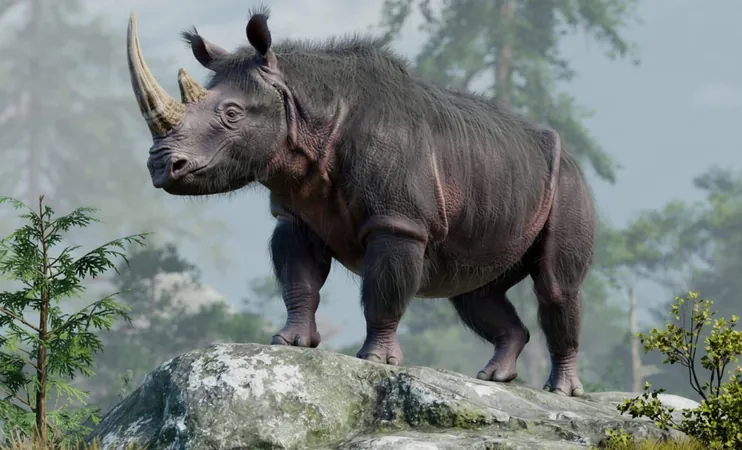
The fossilized remains of *Teleoceras major* illustrate a fascinating lifestyle. With barrel-shaped bodies and high-crowned molars, these rhinos were likely semi-aquatic, akin to modern hippopotamuses. Their anatomy suggests they thrived in wetland habitats, consuming grasses and leafy plants, which might have reduced their need to migrate.
Findings from prior studies at Ashfall revealed that *Teleoceras* had a diet rich in C3 grasses, supported by macrofossils found in their stomachs. Their dental wear patterns indicate a varied diet, suggesting they didn't have to roam in search of seasonal food.
Challenging Assumptions About Ancient Behavior
To explore whether these rhinos migrated due to the volcanic eruption, researchers meticulously sampled the enamel of their molars for dietary and locational changes. Yet, once again, no significant shifts were detected.
Moreover, researchers compared isotope values from *Teleoceras* with other Ashfall inhabitants, such as horses and camels. The rhinos exhibited lower ratios, indicating a preference for wetter environments. Interestingly, the local ruminant species displayed similar isotopic signatures, reinforcing the notion that *Teleoceras* was a resident species, rather than a migratory one.
This extraordinary site challenges our assumptions about ancient animal behavior and offers invaluable insights into the lives of prehistoric creatures, forever altering our perception of the past.

 Brasil (PT)
 Canada (EN)
 Chile (ES)
 Česko (CS)
 대한민국 (KO)
 España (ES)
 France (FR)
 Hong Kong (EN)
 Italia (IT)
 日本 (JA)
 Magyarország (HU)
 Norge (NO)
 Polska (PL)
 Schweiz (DE)
 Singapore (EN)
 Sverige (SV)
 Suomi (FI)
 Türkiye (TR)
 الإمارات العربية المتحدة (AR)