Unearthing the Past: 'Hell Ant' Fossil May Be the Oldest Ant Ever Discovered!
2025-04-24
Author: Wei Ling
A Remarkable Discovery in Brazil
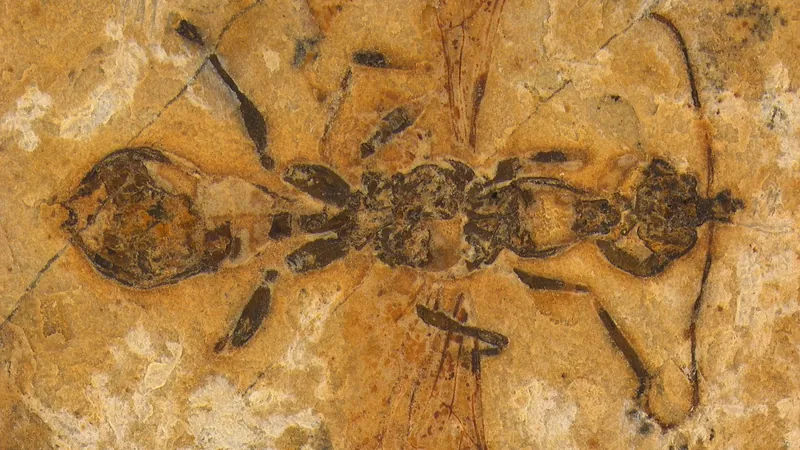
In a stunning breakthrough, scientists have identified what might be the oldest ant fossil ever found, a remarkable specimen dubbed a "hell ant." This ancient insect, unearthed in northeastern Brazil, lived approximately 113 million years ago during the Cretaceous period.
Meet Vulcanidris cratensis!
Named Vulcanidris cratensis, this newly discovered species boasts scythe-like jaws that curve upwards—a tool likely used to seize and impale its prey. "Despite being from an ancient lineage, this species showcased highly specialized anatomical features, hinting at unique hunting behaviors," stated Anderson Lepeco, study co-author and researcher at the Zoological Museum of the University of São Paulo.
The Amazing World of Ants
With over 12,000 species found around the globe in varying habitats—from lush rainforests to arid deserts—ants belong to the family Formicidae, part of the order Hymenoptera, which includes bees and wasps. They are believed to have evolved from wasp-like ancestors around 140 million years ago.
What Makes Hell Ants So Unique?
Hell ants, part of the extinct subfamily Haidomyrmecinae, possessed distinct jaw structures that set them apart from modern ants. Rather than the inward or downward-curving jaws in today’s ants, these ancient predators had unique upward-curving jaws and often sported horn-like projections believed to help them trap prey. One fossil even captured a hell ant in the act of striking its prey, perfectly preserved in amber.
A Fossil of Significance!
The fossil was discovered in limestone at the Crato Konservat-Lagerstätte formation, a region once part of the ancient supercontinent Gondwana. Researchers stumbled upon this significant find in a collection at their museum, recognizing its potential to redefine our understanding of ant evolution. "This finding shines a light on Brazilian paleontology and the diverse, underexplored fossil insect fauna of our country," Lepeco remarked.
Revolutionizing Our Understanding of Ant Evolution
This extraordinary specimen marks not only the earliest ant ever discovered but also the first known hell ant preserved in rock. Using micro-computed tomography imaging, the researchers confirmed its classification, establishing that these fascinating traits emerged earlier than previously thought.
What This Means for the Future!
The implications of this discovery challenge long-held assumptions about the speed at which ants developed complex adaptations. The intricate morphology of Vulcanidris cratensis suggests these ancient insects had sophisticated hunting strategies remarkably different from any modern relatives.
As we continue to delve into our planet's history, each unearthing brings us closer to understanding the evolutionary marvels of life that once thrived on Earth!

 Brasil (PT)
 Canada (EN)
 Chile (ES)
 Česko (CS)
 대한민국 (KO)
 España (ES)
 France (FR)
 Hong Kong (EN)
 Italia (IT)
 日本 (JA)
 Magyarország (HU)
 Norge (NO)
 Polska (PL)
 Schweiz (DE)
 Singapore (EN)
 Sverige (SV)
 Suomi (FI)
 Türkiye (TR)
 الإمارات العربية المتحدة (AR)