Unlocking Earth's Frozen Past: The Marinoan Snowball and Its Secrets to Survival
2025-04-23
Author: Arjun
The Ice Ages that Shaped Our Planet
During the Neoproterozoic Era, Earth was no stranger to dramatic climate swings, famously experiencing two significant ice ages known as the Sturtian and Marinoan Snowball Earth events. These periods were marked by extreme low-latitude glaciations that suffocated vast regions of the planet under thick ice.
The Mechanisms Behind the Freeze and Thaw
In these snowball conditions, the usual cycle of carbon dioxide (CO2) consumption through silicate weathering comes to a stop, allowing atmospheric CO2 to accumulate from volcanic eruptions. Eventually, when atmospheric CO2 reaches a critical mass, it triggers a greenhouse effect powerful enough to melt the ice.
The Crucial Ice Cover Duration
Understanding the duration and reach of ice cover is vital not just for our understanding of Earth's history but also for assessing habitability on exoplanets. While the Sturtian glaciation lasts around 56 million years, the Marinoan glaciation's exact length remains shrouded in uncertainty, estimated between 4 to 15 million years.
New Findings: The Marinoan Glaciation in Namibia
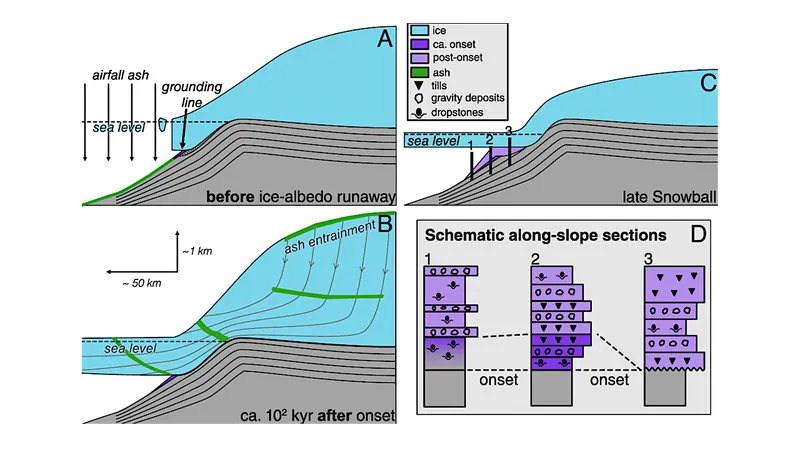
Recent studies suggest that the Marinoan glaciation in Namibia lasted approximately 4 million years, featuring minimal vertical movement of less than 10 meters in the ice grounding line. This stability amid ice advance and retreat highlights a fascinating aspect of the hard snowball state.
Diverse Paths to Deglaciation
The differences in glaciation durations reveal the diverse pathways to deglaciation. The Sturtian experienced slower CO2 accumulation, whereas the Marinoan was marked by rapid radiative changes. This short-lived glaciation may have played a critical role in the emergence and evolution of animal life on Earth and suggests possible pathways for habitability on distant worlds.
The Insight for Exoplanets
What can we learn from the Marinoan? Its brief but intense glacial period not only offers insights into our planet's resilience but also hints at potential habitability on exoplanets, showcasing that even in extreme conditions, life can emerge when the ice finally melts.
 Brasil (PT)
 Canada (EN)
 Chile (ES)
 Česko (CS)
 대한민국 (KO)
 España (ES)
 France (FR)
 Hong Kong (EN)
 Italia (IT)
 日本 (JA)
 Magyarország (HU)
 Norge (NO)
 Polska (PL)
 Schweiz (DE)
 Singapore (EN)
 Sverige (SV)
 Suomi (FI)
 Türkiye (TR)
 الإمارات العربية المتحدة (AR)