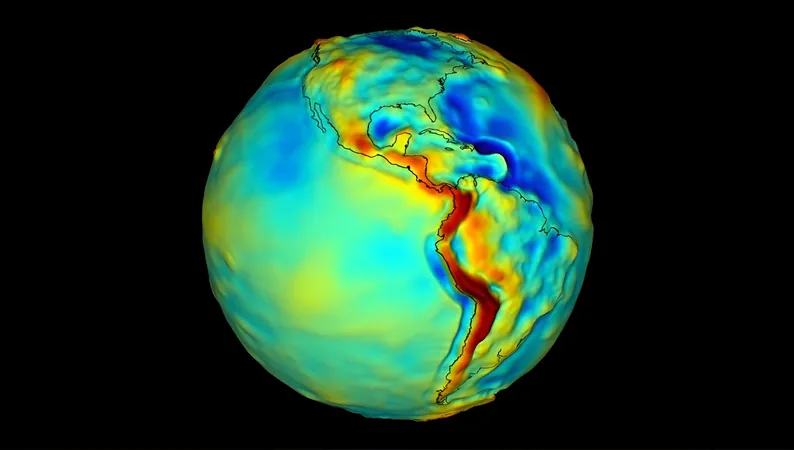
Unlocking Earth's Secrets: NASA's Quantum Leap into Gravity Mapping
2025-04-19
Author: Jia
NASA's Groundbreaking Quantum Sensor Mission
Prepare for an astronomical breakthrough! NASA is gearing up to launch a revolutionary quantum sensor into orbit that promises to unveil the hidden mysteries of Earth's gravity. This ambitious project, set to take off by the end of the decade, aims to reveal everything from shifts in global water availability to undiscovered oil and gas deposits.
A Collaboration of Minds and Innovation
After two decades of meticulous planning, a dynamic team comprising private enterprises, top universities, and the renowned Jet Propulsion Laboratory (JPL) is on the verge of achieving a milestone in scientific exploration. Spearheaded by Jason Hyon, JPL's chief technologist for Earth Science, the project is dubbed the Quantum Gravity Gradiometer Pathfinder (QGGPf).
The Art of Detecting Gravity Shifts
At the heart of this mission lies a cutting-edge gravity gradiometer—a sophisticated tool designed to detect minute variations in gravitational pull. These subtle shifts are often imperceptible in daily life but play a crucial role in revealing what lies beneath our land and oceans.
Revolutionizing Measurements with Frozen Atoms
The magic of the QGGPf mission hinges on rubidium atoms, which are chilled to near absolute zero. These supercooled atoms will be sent into free fall, allowing scientists to measure how gravity pulls on them with exquisite precision. By analyzing the variations in the acceleration of two clouds of these atoms, the team can uncover minute shifts in gravity.
A Leap Towards Precision
Unlike current space-based gravity missions that deploy multiple satellites, QGGPf brings a compact yet powerful approach. Weighing around 275 pounds and occupying just 0.3 cubic yards, this single-satellite mission is designed to house complex laser and vacuum systems capable of exceptional data collection.
Impacting Resource Management and Infrastructure
The ability to detect small-scale gravitational variations could be game-changing. It could help pinpoint underground aquifers or areas susceptible to geological shifts, crucial for communities dependent on fresh water. "We could even calculate the mass of the Himalayas using atoms," Hyon declared, highlighting the vast potential of this technology.
Innovating Through Collaboration
Funded by NASA’s Earth Science Technology Office, QGGPf exemplifies how partnerships between governmental agencies and smaller businesses can expedite technological advancements. The team's efforts focus on ensuring the instrument's sensitivity and precision during operations.
Charting the Hidden Dimensions of Earth
Gravity dictates that heavier masses result in stronger pulls. Thus, a system capable of detecting even the slightest mass discrepancies can generate detailed maps of rock density and subsurface water distribution. By frequently comparing local gravity, scientists can monitor shifts resulting from melting glaciers or reducing groundwater reserves.
Towards a New Era of Quantum Exploration
If successful, the QGGPf project will usher in a new generation of quantum sensors, capable of detecting gravitational signals from even the most concealed features of our planet. This advancement holds the promise of redefining everything from resource management to fundamental planetary science.
The Future Awaits
As the scientific community eagerly anticipates the launch of QGGPf, the excitement continues to build over its potential implications. This groundbreaking mission not only has the power to change our understanding of Earth's geological dynamics but also sets a precedent for studying gravitational fields beyond our planet. Get ready for a paradigm shift in how we perceive and explore our universe!
 Brasil (PT)
 Canada (EN)
 Chile (ES)
 Česko (CS)
 대한민국 (KO)
 España (ES)
 France (FR)
 Hong Kong (EN)
 Italia (IT)
 日本 (JA)
 Magyarország (HU)
 Norge (NO)
 Polska (PL)
 Schweiz (DE)
 Singapore (EN)
 Sverige (SV)
 Suomi (FI)
 Türkiye (TR)
 الإمارات العربية المتحدة (AR)