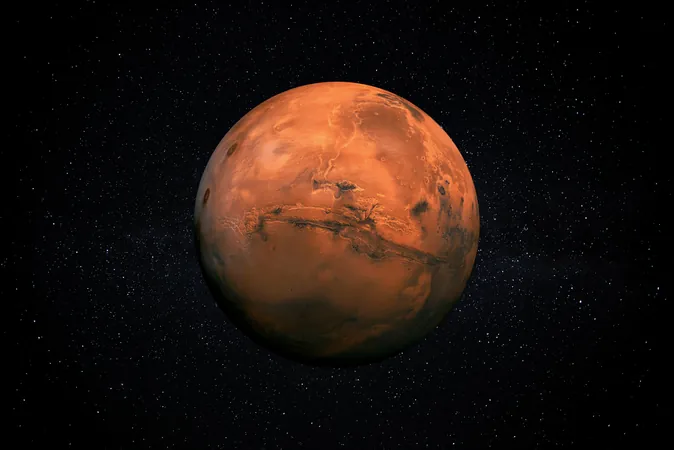
Unlocking Mars: New Study Reveals Volcanic Secrets and Clues to Ancient Life!
2025-04-22
Author: Wei
Mars: A Treasure Trove of Ancient Secrets
A captivating new study from Texas A&M University uncovers the volcanic past of Mars, hinting at its potential for ancient life. The research focuses on Jezero Crater, the landing site for NASA's Perseverance rover, which might be the key to understanding whether life ever existed on the Red Planet.
Revolutionary Discoveries in Jezero Crater
The study indicates that the floor of Jezero Crater is made up of a diverse set of iron-rich volcanic rocks. This treasure trove offers a glimpse into Mars' formative years and creates an exciting opportunity to search for signs of ancient life. Dr. Michael Tice, a geobiologist at Texas A&M, emphasizes the importance of these findings, stating, "Analyzing these diverse volcanic rocks sheds light on the processes that formed this significant region of Mars, enhancing our understanding of its geological history and its potential to support life."
Perseverance: Mars' Robotic Pioneer
Landed on February 18, 2021, Perseverance is NASA's most advanced robotic explorer, scouring Jezero Crater for signs of microbial life. Its mission involves collecting core samples of Martian rock and soil, which could be analyzed back on Earth. Equipped with high-tech tools, Perseverance is analyzing Martian rock compositions and searching for compounds indicative of past life.
Advanced Technology Reveals New Insights
With its groundbreaking camera systems, Perseverance captures unprecedented details of rock textures. Unlike previous rovers, this technological marvel allows for new insights at a level previously unattainable. Tice and his team utilized the Planetary Instrument for X-ray Lithochemistry (PIXL), a state-of-the-art spectrometer, to meticulously analyze the geological formations in the Máz formation, providing an exceptional level of detail.
Two Types of Volcanic Rocks Uncovered
The analysis revealed two unique types of volcanic rocks—one dark and iron-magnesium rich, and the other a lighter trachy-andesite containing plagioclase crystals. This shows a complex volcanic history characterized by multiple lava flows with different compositions, indicating a rich geological tapestry.
Clues to Life: Volcanic Activity and Its Implications
These findings suggest that Mars might have experienced prolonged volcanic activity, potentially providing favorable conditions for life. By using thermodynamic modeling, researchers simulated how these rocks formed and discovered that their compositions resulted from processes like fractional crystallization—similar to those found in Earth's active volcanic systems.
What Lies Ahead? Future Analysis of Martian Rocks
Tice proclaims the significance of these findings: "We've selected specific rocks that hold clues to Mars' past environments. When they return to Earth, we will be able to ask more detailed questions about their history and any biological signatures they might hold." This study not only enriches our understanding of Mars but also ignites the hope of revealing whether life once thrived on the distant planet.
 Brasil (PT)
 Canada (EN)
 Chile (ES)
 Česko (CS)
 대한민국 (KO)
 España (ES)
 France (FR)
 Hong Kong (EN)
 Italia (IT)
 日本 (JA)
 Magyarország (HU)
 Norge (NO)
 Polska (PL)
 Schweiz (DE)
 Singapore (EN)
 Sverige (SV)
 Suomi (FI)
 Türkiye (TR)
 الإمارات العربية المتحدة (AR)