Unlocking the Mysteries of Time: Scientists Discover Mind-Bending Flashes of Light
2025-04-23
Author: Daniel
A Breakthrough in Understanding Time and Light
In an astonishing twist of scientific exploration, researchers from the University of Rostock and the University of Birmingham have shattered long-standing conventions in physics. They've unlocked the secrets of light that seem to flicker into existence from nothing, akin to magic but deeply rooted in mathematics. Their groundbreaking research is now making waves in the prestigious journal Nature Photonics.
The Unique Dimension of Time
Time—unlike our familiar spatial dimensions—is a one-way street. The ticking of the clock moves forward, never back, and scientists have pondered its quirks for decades. The renowned British astrophysicist Sir Arthur Eddington famously discussed this 'arrow of time' in his 1927 lectures, highlighting the strange and often overlooked nature of time within the realm of physics.
Rethinking Time's Role in Physics
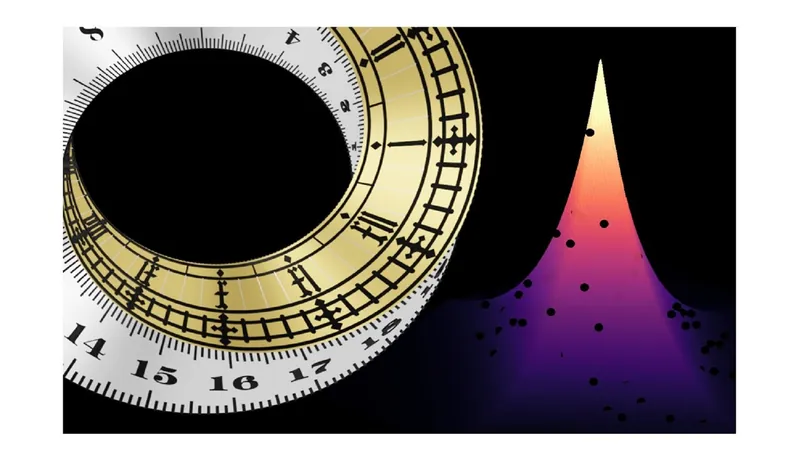
Recent advancements in spatiotemporal crystals—unique objects displaying repeating patterns in both time and space—have sparked a revolution in how we view the dimension of time. This progress raises an exciting question: Can the singular characteristics of time lead to new effects that hold practical applications?
Revelations from the Lab
Taking on this challenge, the research team made a pivotal discovery: they demonstrated that light can be made to appear anchored to a single point in space-time. As depicted by Prof. Alexander Szameit from the University of Rostock, they liken this phenomenon to a biblical creation: "In the beginning, there is nothing. Then physics says, 'Let there be light!,' and voila, light exists—at one precise instant in time and at one specific point in space."
The Mathematical Foundation Behind the Magic
These ephemeral flashes of light aren't mere coincidences; they spring from solid mathematical principles. Prof. Hannah Price from the University of Birmingham elaborates, "Topology, a fundamental branch of mathematics, actually dictates certain behaviors of light in these experiments."
Robust Against External Disturbances
Thanks to the unique qualities of time, these events in space-time exhibit remarkable resilience against disruptions. As Dr. Joshua Feis from the University of Rostock explains, they are safeguarded against random experimental noise and stray light—challenges that have plagued known states of light.
Potential Applications Await
Dr. Sebastian Weidemann, another key member of the research team, points out, "This inherent protection is incredibly valuable—it could enable the precise manipulation of light waves for vital applications in areas like imaging, communications, and lasers."
A New Dawn for Physics and Technology
These findings set the stage for a fascinating future, revealing how a fresh perspective on the interplay between time, space, and topology can both enrich fundamental science and pave the way for innovative applications. The exploration of this 'new-old' dimension has only just begun, propelling us toward potentially groundbreaking discoveries.
 Brasil (PT)
 Canada (EN)
 Chile (ES)
 Česko (CS)
 대한민국 (KO)
 España (ES)
 France (FR)
 Hong Kong (EN)
 Italia (IT)
 日本 (JA)
 Magyarország (HU)
 Norge (NO)
 Polska (PL)
 Schweiz (DE)
 Singapore (EN)
 Sverige (SV)
 Suomi (FI)
 Türkiye (TR)
 الإمارات العربية المتحدة (AR)