Unlocking the Quantum Zoo: Scientists Unveil a Dozen New 'Species'
2025-04-21
Author: John Tan
Welcome to the Quantum Zoo
In an astonishing breakthrough, scientists have just expanded the intriguing realm of quantum physics by identifying over a dozen new quantum states. These states, previously confined to theoretical discussions, represent a vibrant 'zoo' of possibilities lying in wait—ready to redefine our understanding of quantum matter.
A Discovery Beyond Expectations
In a recent publication in *Nature*, Xiaoyang Zhu, the Howard Family Professor of Nanoscience at Columbia, announced that some of these states had never been observed before, remarking, "We didn't expect to see so many either!" This new discovery opens doors to the development of a revolutionary type of quantum computer known as a topological quantum computer, which promises to mitigate many of the errors plaguing current quantum computing technologies.
Magnetic Challenges Overcome
Topological quantum computers are theorized to possess quantum properties that enhance their stability, but traditionally, creating the necessary topological states has required external magnets. Remarkably, Zhu's team has identified states that can be generated without magnets, utilizing the unique features of twisted molybdenum ditelluride.
Historical Roots of the Hall Effect
The recently discovered states are believed to connect to the well-known Hall effect, first identified in 1879. This phenomenon occurs when electrons flow along a metal strip and cluster at its edges in response to a magnetic field. Under ultra-cold conditions and in two dimensions, this behavior leads to quantized voltage changes—turning classical physics on its head.
Fractional Quantum Hall Effect: A Historic Quirk
Columbia Professor Emeritus Horst Stormer, a 1998 Nobel laureate, shed light on the fractional quantum Hall effect, where groups of electrons create new particles with fractional charges, challenging the conventional understanding of charge. Researchers have sought to observe this peculiar effect across various materials, making significant progress in 2023 thanks to Xiaodong Xu’s innovative research.
The Magic of Moiré Patterns
At the heart of this discovery lie moiré materials, which consist of ultra-thin layers twisted together. This twisting creates a unique honeycomb structure with properties that surpass those of individual layers. The topological characteristics of twisted molybdenum ditelluride allow electrons to secure themselves in configurations that lead to the creation of fractional charges without needing an external magnetic field.
Exciting Experimental Advances
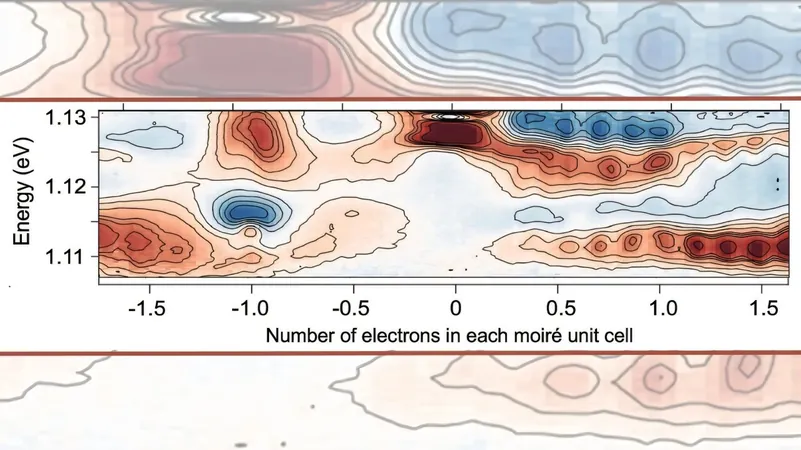
Last summer, Yiping Wang from Columbia made a pivotal breakthrough when experimenting with a sample from Xu’s lab. Using an advanced pump-probe spectroscopy technique, she detected a dazzling array of fractional charges, some of which have been theorized as crucial components for constructing a topological quantum computer.
A New Frontier in Quantum Research
Their sophisticated pump-probe method not only identifies these new quantum states but captures critical dynamics while they evolve. Wang shared her excitement, stating, "We’ve entered a new temporal dimension to probe correlation and topology in the ground state." The potential applications of these new states could be revolutionary.
The Next Steps in Quantum Exploration
As researchers delve deeper into these newly unearthed states, the quest to fully understand their properties and potential applications continues. Zhu emphasized the excitement surrounding these findings, expressing hope that this work will inspire further exploration of the vast quantum zoo.
The universe of quantum physics is indeed a captivating and complex realm, and it appears we've only just begun to explore its myriad wonders.
 Brasil (PT)
 Canada (EN)
 Chile (ES)
 Česko (CS)
 대한민국 (KO)
 España (ES)
 France (FR)
 Hong Kong (EN)
 Italia (IT)
 日本 (JA)
 Magyarország (HU)
 Norge (NO)
 Polska (PL)
 Schweiz (DE)
 Singapore (EN)
 Sverige (SV)
 Suomi (FI)
 Türkiye (TR)
 الإمارات العربية المتحدة (AR)