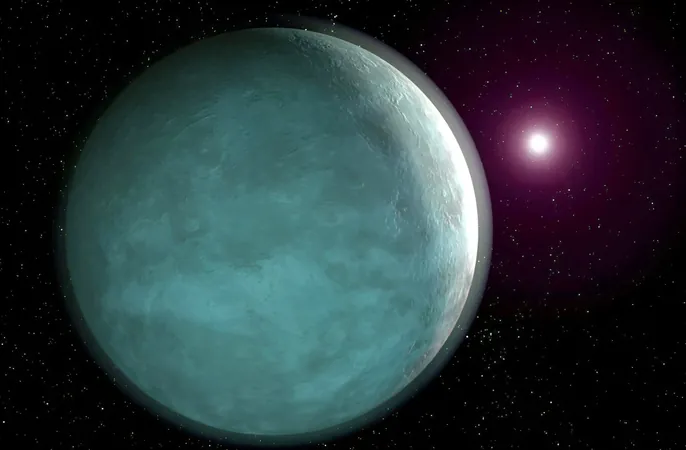
Unlocking the Secrets of a Scorching Exoplanet: TOI-270 d Revealed!
2025-04-20
Author: Mei
A groundbreaking study has delved into the mysteries of TOI-270 d, an exoplanet just 73 light-years away from Earth, unlocking vital clues about planetary evolution.
Despite its size being between Earth and Neptune, researchers now believe TOI-270 d is a hot, rocky planet enveloped in a thick atmosphere—quite different from the earlier notion of it being a water-rich 'Hycean' world.
What Makes TOI-270 d So Special?
Led by the Southwest Research Institute (SwRI), this study offers insights into the elusive sub-Neptune category of planets. Christopher Glein, the study's lead author, states, "Sub-Neptunes are one of the hottest topics in exoplanetary science. They are mainly absent from our solar system but dominate the galaxy." He adds that temperate versions of these planets are particularly intriguing as some might even have the potential for habitability.
The Enigma of Sub-Neptune Planets
Since the exoplanet revolution began, size variations between Earth and Neptune have perplexed scientists. These sub-Neptunes appear prevalent in cosmic surveys but are conspicuously absent from our own solar system, prompting a flurry of theories regarding their origins and composition.
Initial ideas posited that some of these planets could be vast ocean worlds with hydrogen-rich atmospheres, coining the term "Hycean." However, observations from the James Webb Space Telescope (JWST) present a more straightforward picture: TOI-270 d seems to have a heated rocky core shrouded by a scorching atmosphere.
Glein remarked, "The JWST data on TOI-270 d is revolutionary, showing a level of detail that could redefine our understanding of alien worlds. We've detected molecules such as carbon dioxide, methane, and water that allow us to investigate its geochemistry and origins.
Temperature Surprises and Geochemical Revelations
With temperatures soaring above 1,000 degrees Fahrenheit, TOI-270 d's environment negates the previously theorized expansive oceans of the Hycean model. Rather, the new geochemical frameworks indicate that high temperatures could facilitate complex gaseous reactions at its molten surface.
Though disappointing in terms of habitability prospects, Glein emphasizes that this planet provides an exceptional chance to explore various routes of planetary evolution, revealing the wild configurations that nature can create.
The Mystery of Missing Ammonia
Another intriguing puzzle presented by these sub-Neptunes is the apparent absence of ammonia in many atmospheres, despite theories suggesting its formation in thick, hydrogen-rich environments.
Glein's team illustrates how different processes—including high-temperature nitrogen gas production and ammonia dissolving in molten rock—might work together to explain this anomaly.
Exploring Planetary Chemistry Exoplanetary Style!
This research demonstrates how tactics once reserved for our solar system's exploration are now being applied to the enigmatic worlds beyond. By detecting vital molecules like carbon dioxide and methane, scientists are gaining insights into the interactions of these compounds on scorching exoplanets.
With advancements like the JWST, our understanding of exoplanetary geochemistry is evolving rapidly, paralleling past achievements in studying our own solar system's planets.
TOI-270 d: A Rosetta Stone for Exoplanet Research
Positioned as a 'Rosetta Stone' for unravelling the sub-Neptune mystery, TOI-270 d illustrates just how diverse alien planetary systems can be compared to our Sun's system.
Through precise observations and sophisticated modeling, scientists are getting closer to identifying the signs of chemical and geological processes that govern these cosmic bodies. Each new exoplanet study brings us one step closer to uncovering the potential for habitable environments in the universe.
The findings from this incredible study will soon be published in The Astrophysical Journal, marking a pivotal moment in our exploration of the universe.
 Brasil (PT)
 Canada (EN)
 Chile (ES)
 Česko (CS)
 대한민국 (KO)
 España (ES)
 France (FR)
 Hong Kong (EN)
 Italia (IT)
 日本 (JA)
 Magyarország (HU)
 Norge (NO)
 Polska (PL)
 Schweiz (DE)
 Singapore (EN)
 Sverige (SV)
 Suomi (FI)
 Türkiye (TR)
 الإمارات العربية المتحدة (AR)