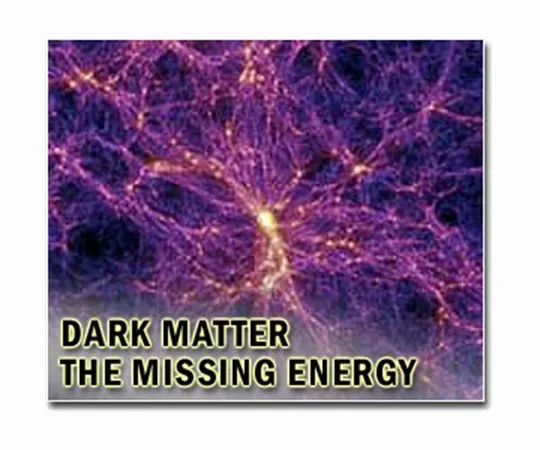
Unlocking the Secrets of Dark Matter: A Pathway to Discovery Within 15 Years!
2025-04-22
Author: Yu
Game-Changing Discovery in Dark Matter Research!
Exciting news from the frontiers of astrophysics! Researchers from King’s College London, Harvard University, and UC Berkeley have revealed a groundbreaking method for detecting dark matter that could lead to significant breakthroughs in as little as 15 years!
Introducing the 'Cosmic Car Radio'
This innovative technique involves a revolutionary device likened to a "cosmic car radio," specifically designed to detect mysterious particles called axions—hailed as among the most promising candidates for dark matter. With dark matter comprising a staggering 85% of the universe's mass yet remaining unseen, the potential implications of this research are monumental.
How Does It Work?
In a study featured in the esteemed journal Nature, the team unveiled the design for a sophisticated detector capable of scanning for axions across a broad frequency range. These elusive particles are predicted to behave like waves, oscillating in frequencies from audible kilohertz to the ultra-high terahertz spectrum. The researchers have developed a special axion quasiparticle (AQ) that reacts to these frequencies.
A Remarkable Material Behind the Magic
The AQ detector is made from manganese bismuth telluride (MnBi2Te4), known for its remarkable magnetic and electronic properties. By engineering this material into ultra-thin layers, the team amplified its sensitivity and finely tuned its quantum features. Lead author Jian-Xiang Qiu emphasized the technical finesse required: reducing the material to just a few atomic layers was essential for achieving the perfect sensitivity.
A New Era in Dark Matter Detection!
Dr. David Marsh, a co-author and Ernest Rutherford Fellow at King’s College London, likened this new device to a sophisticated radio receiver, stating, "We can now build a dark matter detector that is essentially a cosmic car radio, tuning into the frequencies of the wider galaxy until we find the axion!" With current technology at hand, the challenge now lies in scaling it effectively.
The Road Ahead: Plans for Scaling Up!
The research team plans to upscale the AQ detector within the next five years, followed by an ambitious ten-year quest to probe relevant high-frequency bands. When the detector tunes into the frequency of an axion, it is expected to emit tiny flashes of light—offering the first tangible proof that dark matter has been detected!
A Surge of Interest in Axions!
Dr. Marsh notes the growing scientific enthusiasm surrounding axions, paralleling the excitement that preceded the Higgs boson discovery. He remarks, "Theorists proposed that axions acted like a radio frequency in 1983, and now we can tune in to it— we are closing in on the axion and fast!" This captivating research holds the promise of unveiling one of science's greatest mysteries!
 Brasil (PT)
 Canada (EN)
 Chile (ES)
 Česko (CS)
 대한민국 (KO)
 España (ES)
 France (FR)
 Hong Kong (EN)
 Italia (IT)
 日本 (JA)
 Magyarország (HU)
 Norge (NO)
 Polska (PL)
 Schweiz (DE)
 Singapore (EN)
 Sverige (SV)
 Suomi (FI)
 Türkiye (TR)
 الإمارات العربية المتحدة (AR)