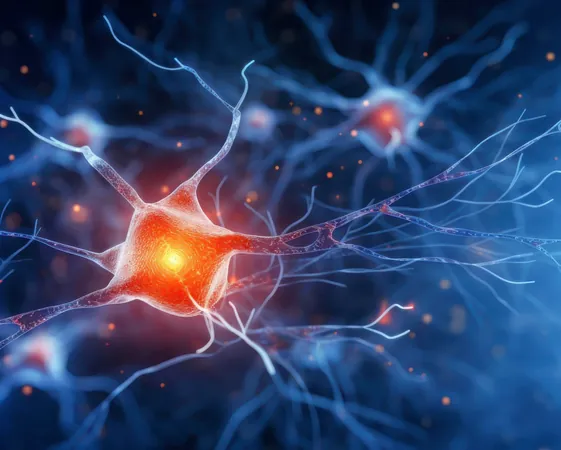
Unlocking the Secrets of Learning: How Your Brain Outsmarts Itself
2025-04-19
Author: Jia
The Brain's Mastery of Learning: A Surprising Discovery
Imagine your brain as a supercomputer, constantly adapting and evolving as you take on new tasks—from learning a new skill at work to memorizing your favorite song. Recent research reveals that this incredible capability is rooted in a process called neural self-reinvention.
Unraveling the Mystery of Synaptic Plasticity
Every time we practice something new, the connections between our neurons—known as synapses—make tiny adjustments. Some synapses amp up their signals to lock in important details, while others dial down to eliminate distractions. This process, termed synaptic plasticity, has long puzzled neuroscientists, especially when it comes to understanding how the brain decides which synapses to adjust.
A Breakthrough Study from UC San Diego
A groundbreaking study from the University of California San Diego sheds light on this mystery. Utilizing advanced brain imaging techniques, researchers led by postdoctoral researcher William Wright tracked the brains of mice as they acquired new motor skills.
Using state-of-the-art two-photon microscopy, the team captured real-time images of brain activity at an unprecedented level of detail, allowing them to observe both input and output patterns in neurons during learning. This complex technology required years of refinement and significant research funding.
Challenging Old Assumptions About Neurons
Traditionally, scientists believed that neurons followed a uniform plasticity rule, where the same electrical spike pattern would affect all synapses equally. However, Wright and his team discovered a much more nuanced reality: different parts of the same neuron can follow distinct learning rules simultaneously.
In their observations, one set of synapses strengthened while others weakened, all within the same neuron. This suggests that neurons operate more like multi-core processors, each compartment handling separate tasks rather than adhering to a one-size-fits-all learning model.
Implications for AI and Neurological Health
This discovery not only redefines our understanding of neural learning but also has exciting implications for artificial intelligence. Modern AI architectures typically apply a single learning rule across all processes, but the findings from UC San Diego suggest that employing distinct learning strategies within a single node could lead to more advanced AI capabilities.
On the healthcare side, understanding that neurons fine-tune different sets of synapses opens new avenues for treating neurological disorders. Clinicians could potentially target specific compartments to mitigate issues in conditions like PTSD, Alzheimer's, and more.
The Road Ahead: Decoding the Learning Process
With this research, the path is set for further inquiry into how neurons allocate their learning resources. Scientists aim to identify specific molecular tags that dictate which synapse follows which rule, looking at factors like neurotransmitter receptors and local cellular activity.
This revelation that a single neuron is a mosaic of specialized learning mechanisms not only propels neuroscience towards a more comprehensive understanding of brain function but also holds promise for creating smarter artificial systems.
Why This Matters to You
As we continue to explore the complexities of the brain, recognizing its astonishing adaptability offers hope for overcoming various mental health challenges and enhancing artificial intelligence. This is just the beginning of our journey into the intricacies of how we learn and adapt.
 Brasil (PT)
 Canada (EN)
 Chile (ES)
 Česko (CS)
 대한민국 (KO)
 España (ES)
 France (FR)
 Hong Kong (EN)
 Italia (IT)
 日本 (JA)
 Magyarország (HU)
 Norge (NO)
 Polska (PL)
 Schweiz (DE)
 Singapore (EN)
 Sverige (SV)
 Suomi (FI)
 Türkiye (TR)
 الإمارات العربية المتحدة (AR)