Unlocking the Secrets of Neutron Star Mergers: How Magnetic Fields Twist Our Understanding
2025-04-20
Author: Mei
The Mysteries of Neutron Star Collisions
Neutron star mergers are explosive collisions between neutron stars—massive remnants of supergiant stars that have collapsed under their own gravity. These cosmic events not only unleash powerful gravitational waves but also provide a unique window into the behavior of matter under extreme conditions.
Gravitational Waves: A Window into the Universe
The collisions generate gravitational waves, which are ripples in space-time caused by the disturbance of massive bodies. Scientists have delved deep into understanding these waves to glean insights into how matter behaves at incredibly high densities, framed by a theoretical model known as the equation of state (EoS). However, researchers have often overlooked the significant role of magnetic fields in affecting these gravitational wave observations.
Groundbreaking Research on Magnetic Influences
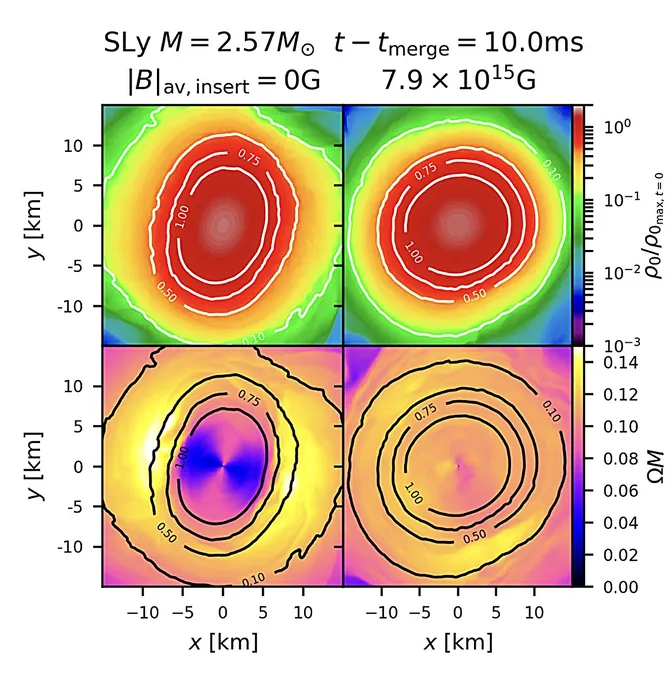
A recent study led by researchers from the University of Illinois Urbana-Champaign and the University of Valencia takes a bold step forward. Their simulations reveal that magnetic fields can dramatically influence the oscillating frequencies of neutron stars after a merger, altering how these cosmic collisions are interpreted. This paper, published in Physical Review Letters, marks a turning point in how we analyze neutron star mergers.
Lead author Antonios Tsokaros highlighted the importance of accurately identifying the oscillation frequencies: "Next-generation gravitational wave observatories like Cosmic Explorer will enable us to detect the dynamics of neutron star formations in real-time, capturing their oscillation characteristics, which hold key clues about their nature."
The Enigmatic Nature of Neutron Stars
Neutron stars remain one of the most fascinating subjects in astrophysics, primarily due to two defining characteristics. Firstly, their core possesses unique thermodynamic properties, exemplified by the fact that a mere spoonful of neutron star material weighs as much as Mount Everest! Secondly, during mergers, their magnetic fields can skyrocket to over a billion times the strongest fields created on Earth.
Magnetic Fields: A Game Changer?
Tsokaros and his team conducted groundbreaking simulations using general relativistic magnetohydrodynamics to investigate the relationship between magnetic fields and oscillation frequencies in post-merger neutron stars. They factored in different neutron star masses, equations of state, and magnetic field configurations in their meticulous research.
Postdoctoral researcher Jamie Bamber stated, "Our findings revealed that the merger amplifies the magnetic field to astonishing levels. This elevated frequency caused by the magnetic field can mask other frequency shifts linked to EoS variations, complicating data interpretation significantly."
A Call for New Exploration
Professor Milton Ruiz emphasized the need to include magnetic effects in assessing the post-merger phase of binary neutron stars, warning, "Ignoring this factor could lead to inaccurate conclusions regarding the physical properties of these cosmic systems."
The Future of Gravitational Wave Astronomy
This pivotal research opens new doors for understanding gravitational wave data from neutron star mergers. As Tsokaros and his team plan to refine their simulations, they anticipate even higher resolutions that were previously unattainable. Professor Stuart L. Shapiro noted the landmark moment in 2017 when LIGO and NASA satellites first detected gravitational waves paired with a gamma-ray burst from a neutron star merger, establishing a new frontier in multi-messenger astronomy.
With upcoming advancements in detection technology like the upcoming Einstein Telescope and Cosmic Explorer, scientists are poised to reveal the detailed intricate features of these cosmic phenomena, unlocking even more secrets of the universe.

 Brasil (PT)
 Canada (EN)
 Chile (ES)
 Česko (CS)
 대한민국 (KO)
 España (ES)
 France (FR)
 Hong Kong (EN)
 Italia (IT)
 日本 (JA)
 Magyarország (HU)
 Norge (NO)
 Polska (PL)
 Schweiz (DE)
 Singapore (EN)
 Sverige (SV)
 Suomi (FI)
 Türkiye (TR)
 الإمارات العربية المتحدة (AR)