Unlocking the Secrets of Phosphorus in the HD 100546 Protoplanetary Disk
2025-04-22
Author: Wei
The Hidden Influence of Phosphorus on Planetary Habitability
Did you know that phosphorus plays a crucial role in determining the habitability of exoplanets? This essential element, intertwined with a planet's formation history, could hold the key to whether life can exist beyond our solar system.
A Deep Dive into the HD 100546 Star System
To unravel the mysteries of phosphorus, scientists have turned their eyes to the well-studied HD 100546 star and its protoplanetary disk. Utilizing advanced high-resolution spectra from both HST/STIS in ultraviolet and APEX in the sub-millimeter spectrum, researchers are working to quantify the phosphorus available in this fascinating environment.
Their findings reveal a phosphorus budget in the star's vicinity measured at log(P/H) ≈ -7.50, indicating a substantial inventory of phosphorus within accreting gas and dust.
The Dynamic Layers of the Disk: What Lies Beneath?
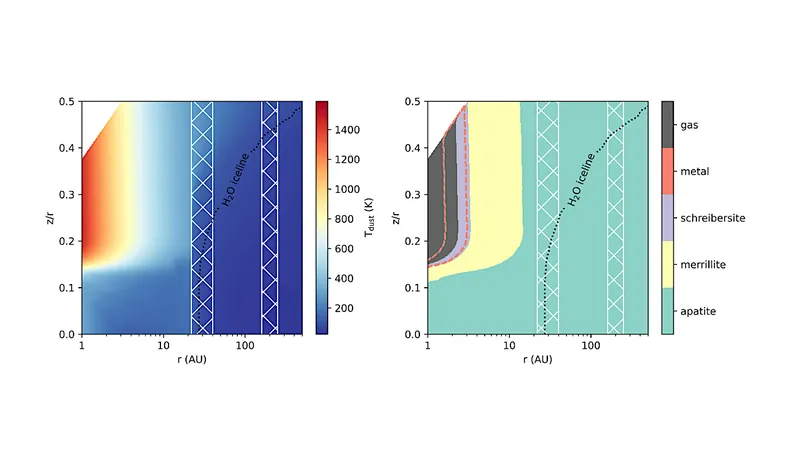
Examining different regions of the disk shows varying phosphorus concentrations: the inner gas registers log(P/H)in ≤ -8.70, while the outer regions measure log(P/H)out ≤ -9.30. Intriguingly, the phosphorus within the disk appears to come from a refractory reservoir, which may include minerals like apatite or schreibersite, suggesting these elements could persist in solid form longer as the disk evolves.
Implications for Protoplanets - The Future of Habitability
But what does this mean for the two protoplanets orbiting HD 100546? The abundant refractory phosphorus could greatly influence their development and, ultimately, their potential for sustaining life.
Setting the Stage for Future Discoveries
This groundbreaking research not only enhances our understanding of the chemical elements crucial for habitability in planetary systems, but also sets a strong foundation for future explorations. Upcoming missions like the James Webb Space Telescope (JWST) and Ariel are poised to delve deeper, potentially studying phosphorus in the atmospheres of distant exoplanets and unveiling new realms of possibility for life beyond Earth.
Stay tuned as we continue to explore the universe's secrets, one element at a time!
 Brasil (PT)
 Canada (EN)
 Chile (ES)
 Česko (CS)
 대한민국 (KO)
 España (ES)
 France (FR)
 Hong Kong (EN)
 Italia (IT)
 日本 (JA)
 Magyarország (HU)
 Norge (NO)
 Polska (PL)
 Schweiz (DE)
 Singapore (EN)
 Sverige (SV)
 Suomi (FI)
 Türkiye (TR)
 الإمارات العربية المتحدة (AR)