Unlocking the Secrets of Planetary Intelligence: A Path to Survival?
2025-04-18
Author: Sarah
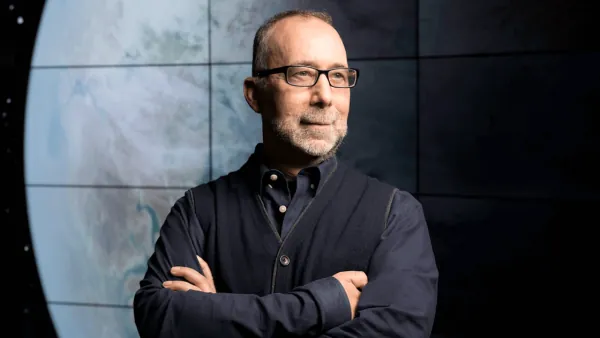
A Call to Action from Astrophysicist Adam Frank
Astrophysicist Adam Frank is sounding the alarm on humanity's future, stating that without urgent action, the climate crisis could spell doom for our species. However, he proposes a groundbreaking concept that could be our saving grace: 'planetary intelligence,' a new scientific perspective emerging from our understanding of life’s interconnectedness on Earth.
From Stars to Sentience: Frank’s Journey
A professor at the University of Rochester and co-founder of the NPR blog 13.7, Frank made his name studying stars and black holes. Yet, he grew disillusioned with the realm of contemporary physics, especially its abstract mathematical theories, which seemed to ignore human experience. This dissatisfaction sparked his curiosity about the essence of life and sentience.
The Gaia Theory Reimagined
Inspired by the work of James Lovelock and Lynn Margulis in the 1970s, who first suggested the Earth functions like a living organism (the Gaia hypothesis), Frank proposes that our planet exhibits a form of intelligence. He explained how Earth's atmosphere has been shaped by life itself, and that these feedback mechanisms keep the planet stable.
What This Means for the Climate Crisis
Frank asserts that it's not about 'saving the Earth'—the planet will persist regardless of human existence. Instead, the focus should be on preserving human civilization. According to him, climate change's repercussions could devastate global populations, leaving a drastically reduced world inhabited by perhaps just half a billion people.
Exploring the Depths of Planetary Intelligence
In a conversation with Steve Paulson, Frank elaborated on what he terms 'planetary intelligence.' This concept emphasizes a collective adaptation to environmental changes, much like early microbial life forming interconnected ecosystems. While not conscious, this collective life form responds to shifts in its surroundings.
Nature’s Network: Connections That Matter
Frank touches on the fascinating idea of 'liquid brains,' distributed intelligences found in nature, exemplified by relationships between tree roots and mycelial networks. These connections enable trees to communicate and share resources, showcasing an intricate form of intelligence across ecosystems.
The Technosphere: A Double-Edged Sword
Just as the biosphere comprises all life, the 'technosphere' encompasses the sum of human-made creations. However, unlike a mature biosphere, our current technosphere lacks self-sustaining qualities and is degrading the environment it depends on. Without significant changes, the stability of human civilization is at risk.
Hope Amid Uncertainty: The Future of Humanity
While challenges loom and certain regions may become uninhabitable, Frank maintains a sense of hope. He believes humanity's resilience will lead to innovative adaptations in response to environmental changes. This could reshape our political economies to prioritize planetary well-being, fostering a sustainable coexistence with Earth.
A New Era Awaits
Ultimately, Frank advocates for a radical shift in our thinking—a new worldview centered on planetary intelligence that embraces the interconnectedness of all life and fosters a sustainable, thriving global community. As we stand on the brink of environmental change, it is clear that our survival depends on reevaluating how we interact with our planet.

 Brasil (PT)
 Canada (EN)
 Chile (ES)
 Česko (CS)
 대한민국 (KO)
 España (ES)
 France (FR)
 Hong Kong (EN)
 Italia (IT)
 日本 (JA)
 Magyarország (HU)
 Norge (NO)
 Polska (PL)
 Schweiz (DE)
 Singapore (EN)
 Sverige (SV)
 Suomi (FI)
 Türkiye (TR)
 الإمارات العربية المتحدة (AR)