Unlocking the Secrets of Soil: How Proteins and Organic Matter Preserve Carbon for Millennia
2025-04-21
Author: Wei Ling
A Crucial Discovery in Climate Science
As global climate change escalates, understanding how soil can capture and store carbon is more vital than ever. These insights are key to enhancing the earth's carbon sinks and bolstering the resilience of our ecosystems.
The Power Players in Carbon Stabilization
Recent research underscores the importance of dissolved organic matter (DOM) and glomalin-related soil protein (GRSP) in the soil carbon reservoir. These components are essential for not just accumulating, but also stabilizing organic carbon over long periods. Yet, the nuances of how they function and interact in different ecosystems have remained largely elusive.
Bridging Research Gaps Over Millions of Years
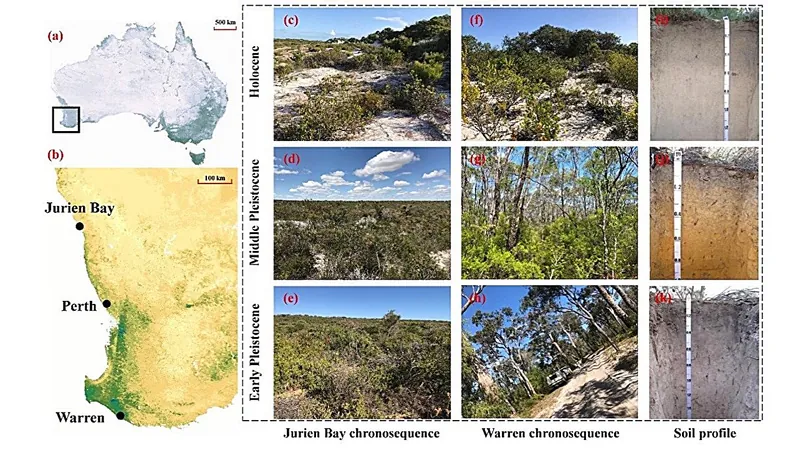
To shed light on these mysteries, scientists from the South China Botanical Garden, part of the Chinese Academy of Sciences, embarked on an ambitious study involving two unique coastal dune sites aged up to 2 million years: Jurien Bay, with its scorching, arid climate, and Warren, where a cooler, wetter environment prevails.
Climate's Impact on Carbon Dynamics
Their findings, published in respected soil science journals like CATENA and Plant and Soil, reveal that Warren’s moist, cold climate fosters higher levels of DOM accumulation compared to the dry conditions of Jurien Bay. This indicates a more robust organic matter stability in the former, driven by differences in vegetation, carbon supply, and soil conditions.
From Nutrient Source to Carbon Stability
The researchers discovered that in the early stages of ecosystem development, DOM levels were abundant and rich in protein-like, microbially-derived substances, providing essential nutrients for both plants and microbes. However, as ecosystems aged and began to degrade, DOM shifted towards stable forms like humic and fulvic acids, effectively enhancing carbon pool stability.
GRSP’s Surprising Role in Carbon Accumulation
Intriguingly, GRSP, particularly a type known as EE-GRSP, showed substantial accumulation in ancient phosphorus-poor soils, even amidst declining arbuscular mycorrhizal fungi (AMF) biomass. This unexpected result stems from plants reallocating carbon underground, thus invigorating AMF turnover, influenced by factors like soil acidity and nutrient balance.
A Game-Changer for Soil Science
This groundbreaking research confirms GRSP's pivotal role in both accumulating and stabilizing soil organic carbon (SOC), maintaining its essential function as a carbon sink, even under long-term nutrient scarcity. By unveiling the distinct mechanisms through which climate and soil formation interact to manage DOM and GRSP, this study offers fresh perspectives on soil carbon dynamics in our changing world.
 Brasil (PT)
 Canada (EN)
 Chile (ES)
 Česko (CS)
 대한민국 (KO)
 España (ES)
 France (FR)
 Hong Kong (EN)
 Italia (IT)
 日本 (JA)
 Magyarország (HU)
 Norge (NO)
 Polska (PL)
 Schweiz (DE)
 Singapore (EN)
 Sverige (SV)
 Suomi (FI)
 Türkiye (TR)
 الإمارات العربية المتحدة (AR)