Unlocking the Secrets of Tardigrades: Revolutionary Ice Lithography Technique
2025-04-19
Author: Siti
A Breakthrough in Micro/Nanofabrication
In the world of modern technology, micro and nanofabrication techniques have transformed photonics and electronics. However, traditional methods have struggled to mesh with living organisms, facing challenges like nonconformal coatings, radiation damage, and toxic solvents.
Introducing Ice Lithography: A Game Changer
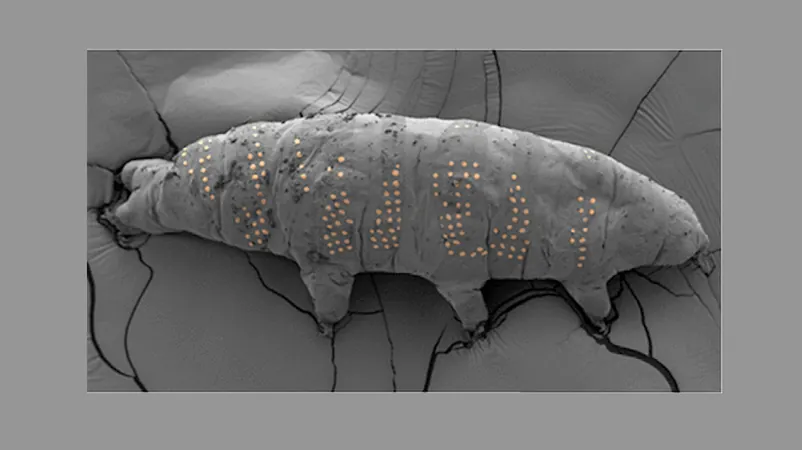
Enter a groundbreaking technique: ice lithography! This innovative method allows scientists to craft detailed micro and nanoscale patterns directly onto the surfaces of tardigrades, those incredible microscopic creatures known for their resilience, while they exist in their cryptobiotic state—essentially a state of suspended animation.
Patterns That Last Even After Reviving!
The most astonishing part? Once these tardigrades are rehydrated, they spring back to life, and – remarkably – they retain the intricate patterns imprinted on their surfaces. This incredible ability opens the door to numerous scientific possibilities!
Precision Meets Resilience
By fine-tuning factors such as ice thickness and beam energy, researchers can achieve patterns as small as 72 nanometers, all while ensuring minimal damage to the fragile organisms. These patterns are not only incredibly tiny but also impressively durable, surviving challenges like stretching, immersion in solvents, rinsing, and drying.
Implications for Future Technologies
This novel approach doesn’t just shed light on the enduring nature of tardigrades; it holds vast potential for fields like cryopreservation, biomedicine, and astrobiology. Imagine the advancements in biosensing technologies, biomimetics, and perhaps even living microrobotics that could stem from integrating advanced fabrication techniques with living systems!
A New Era of Research
The fusion of biology and cutting-edge technology is just beginning. The implications of this research could lead to extraordinary breakthroughs that enable us to harness the capabilities of living organisms in ways we never thought possible!
 Brasil (PT)
 Canada (EN)
 Chile (ES)
 Česko (CS)
 대한민국 (KO)
 España (ES)
 France (FR)
 Hong Kong (EN)
 Italia (IT)
 日本 (JA)
 Magyarország (HU)
 Norge (NO)
 Polska (PL)
 Schweiz (DE)
 Singapore (EN)
 Sverige (SV)
 Suomi (FI)
 Türkiye (TR)
 الإمارات العربية المتحدة (AR)