Unlocking the Secrets of the Universe: Could Hydrogen Gas Clouds Explain Missing Matter?
2025-04-19
Author: Ming
The Great Cosmic Mystery
Did you know that nearly half of the universe's matter is unaccounted for? Scientists are racing to solve this enigma, and new research suggests that hydrogen gas clouds could be the key to unlocking this cosmic puzzle.
A Breakthrough Discovery
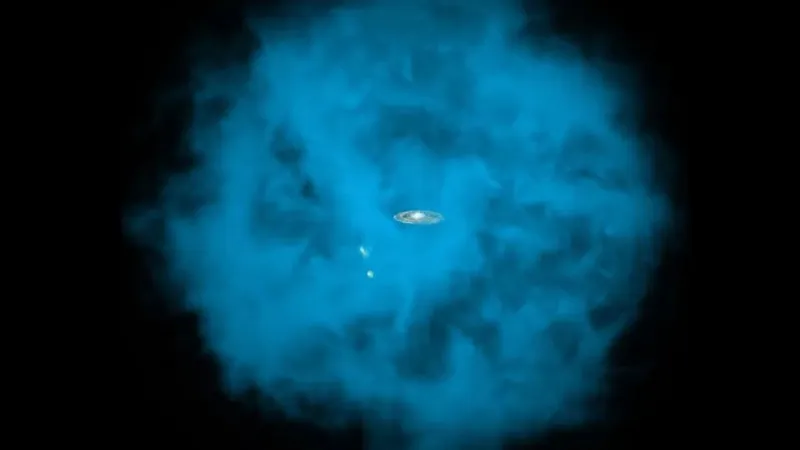
A groundbreaking study led by astronomer Simone Ferraro from the University of California, Berkeley, has revealed that hydrogen gas clouds surrounding galaxies may be far larger than previously thought. This discovery hints that these clouds could potentially explain much of the universe's missing normal matter—a mystery that has baffled scientists for years.
The Hunt for Hidden Matter
Utilizing data from the cutting-edge Dark Energy Spectroscopic Instrument (DESI), the international research team mapped approximately 7 million galaxies. They were able to detect faint halos of ionized hydrogen gas at the outskirts of these galaxies, which have evaded traditional observation methods. By analyzing radiation left over from the Big Bang, the team suggests these halos might form a vast cosmic web, potentially accounting for previously undetected matter.
Rethinking Black Holes
But the implications of this discovery extend beyond just missing matter. It could also reshape our understanding of black holes. Initially believed to expel massive amounts of gas during their early lifecycle, new insights indicate that these enigmatic objects may behave differently than previously imagined. Boryana Hadzhiyska, an astronomer involved in the study, theorizes that black holes might operate in an 'on and off' duty cycle, leading to more frequent interactions than once thought.
What's Next?
As researchers dive deeper into their findings, the next step will be to incorporate these new measurements into existing models of the universe. Hadzhiyska notes that many scientists are eager to conduct a thorough analysis of this newly identified gas, which could unlock further secrets about the universe's composition and the fundamental forces that govern it.
 Brasil (PT)
 Canada (EN)
 Chile (ES)
 Česko (CS)
 대한민국 (KO)
 España (ES)
 France (FR)
 Hong Kong (EN)
 Italia (IT)
 日本 (JA)
 Magyarország (HU)
 Norge (NO)
 Polska (PL)
 Schweiz (DE)
 Singapore (EN)
 Sverige (SV)
 Suomi (FI)
 Türkiye (TR)
 الإمارات العربية المتحدة (AR)