Unraveling the Cosmic Mystery: Are Supermassive Black Holes Creating Bubbles in Our Galaxy?
2025-04-20
Author: Wei
What’s Behind the Strange Bubbles in Our Milky Way?
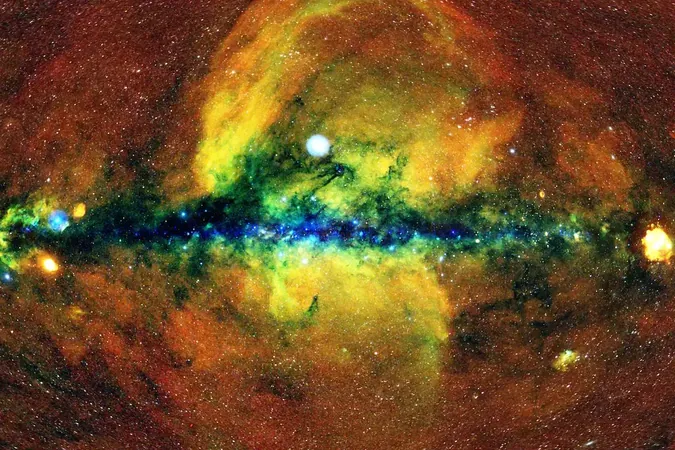
For over 15 years, astronomers have been captivated by mysterious bubbles hovering above and below the disc of our Milky Way galaxy. Detected by the Fermi Gamma-ray Space Telescope, these remarkable structures extend tens of thousands of light-years and seem to be focused around the heart of our galaxy.
The Galactic Center: A Black Hole’s Playground?
New observations from the eROSITA X-ray satellite have uncovered even larger structures, dubbed ‘superbubbles.’ The intriguing alignment of these features with the Galactic center implies that the supermassive black hole residing there might be the architect behind this cosmic phenomenon, particularly due to the high-energy outbursts associated with black hole activity.
A Missing Energy Source?
However, current energy levels emitted from the black hole aren't nearly potent enough to account for the massive bubbles observed. Many theories suggest that, in the not-so-distant past, this black hole was in a dynamic phase of rapid growth, akin to galaxies that host active galactic nuclei. But can our Milky Way truly transition from such energetic states to its current tranquil phase within just a few million years?
A Compelling New Hypothesis?
Recently published simulations offer a fresh perspective. While the black hole is still seen as the culprit, researchers explore the impact of Tidal Disruption Events (TDEs), which occur when stars venture too close and are torn apart. In a galaxy similar to ours, it’s expected that a star should meet this fate roughly every 10,000 to 100,000 years.
Bubbles Born from Cosmic Feasts?
Each TDE generates a massive burst of energy that can propagate through the galaxy, creating conditions ripe for bubble formation. With multiple TDEs over time, researchers have found that these bubbles could be sustained and rejuvenated by a series of cosmic feasts as the black hole snacks on wayward stars.
The Mystery Remains?
While the researchers’ model effectively replicates the features of the Milky Way’s bubbles, discrepancies still linger. The gamma-ray emissions produced don't completely align with the observations from Fermi. However, the authors suggest that various factors—from the frequency of TDEs to the initial conditions of the galaxy—could be adjusted for improved accuracy.
Is This a Cosmic Breakthrough?
This tantalizing hypothesis not only sheds light on the origins of the mysterious bubbles but also opens the door to further exploration into the complex relationship between black holes and galaxies. So, could these vast cosmic bubbles truly be the remnants of a black hole’s celestial appetite? Only time—and further research—will tell!
 Brasil (PT)
 Canada (EN)
 Chile (ES)
 Česko (CS)
 대한민국 (KO)
 España (ES)
 France (FR)
 Hong Kong (EN)
 Italia (IT)
 日本 (JA)
 Magyarország (HU)
 Norge (NO)
 Polska (PL)
 Schweiz (DE)
 Singapore (EN)
 Sverige (SV)
 Suomi (FI)
 Türkiye (TR)
 الإمارات العربية المتحدة (AR)