Unraveling the Future: Engineers Craft 3D ‘Optical Knots’ from Laser Light
2025-04-19
Author: Siti
Forget shoelaces and tangled cords—meet optical knots! In a groundbreaking study from Duke University, engineers have ingeniously manipulated laser beams to create intricate three-dimensional structures known as optical knots, paving the way for revolutionary advancements in technology.
Published in *Nature Communications*, the research team has harnessed the power of laser light to form stationary light structures capable of encoding information and interacting with their environment in extraordinary ways. This has far-reaching implications for secure communication systems, including futuristic holograms.
What Exactly Are Optical Knots?
Optical knots are mesmerizing formations created by overlapping laser beams in precise configurations, resulting in twisted loops and mesmerizing shapes made from light. Discovered only about 20 years ago, this emerging field is ripe for exploration, with potential applications ranging from secure data transmission to capturing tiny particles in three-dimensional space.
Testing the Stability of Optical Knots in Turbulent Air
In their latest experiment, the Duke team sought to answer a crucial question: can these delicate light knots endure the chaos of turbulent air? When it comes to practical applications—like data transmission or atmospheric measurement—strength and stability are essential.
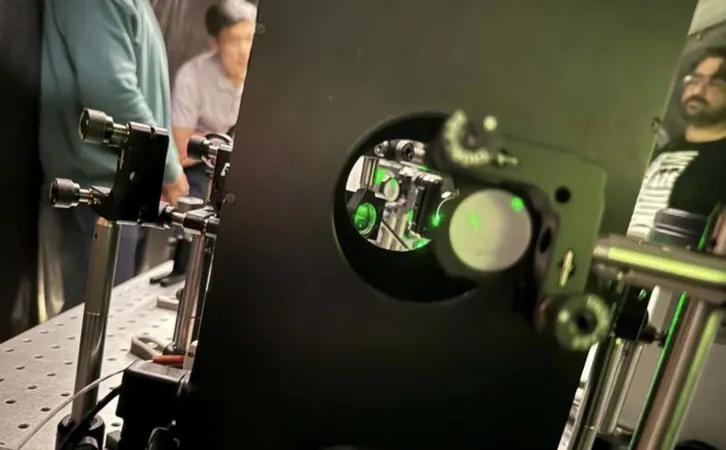
To create their optical knot, the researchers ingeniously developed a holographic light-strip that splits a singular laser beam into five separate strands. These converge to form the optical knot in space. Without the luxury of an expansive lab, they innovatively constructed a tabletop turbulence simulator to replicate challenging air conditions.
"We used a compact device with a heating element and fans to create turbulence," explained Danilo Gomes Pires, a postdoctoral scientist in the lab. "By shrinking the light beam and bouncing it off mirrors, we simulated its journey as if it were traveling nearly 1,000 feet."
The results were revealing. In calm air, the optical knot retained its intricate three-loop structure. However, as turbulence increased, the knot began to unravel, losing both its form and its data-carrying capabilities.
Enhancing Stability for Future Applications
To improve the stability of the knots, the researchers redesigned them to be more complex, adding twists and curves that serve as "reference points," much like the supports of a roller coaster. These enhanced knots demonstrated greater resilience, managing to maintain their shape even in challenging conditions.
Beyond Communication: The Versatility of Optical Knots
Although still in its infancy, mastering the creation and stabilization of optical knots opens up a realm of possibilities. These knots could encode and transmit information over vast distances, akin to sending a holographic Morse code. Moreover, they could serve as innovative tools for measuring atmospheric turbulence by analyzing changes in light patterns during passage.
With their three-dimensional capabilities, optical knots could even be utilized to capture and manipulate microscopic particles, facilitating advanced experiments in physics and biology.
"Before we can implement optical knots in practical applications, we need to study and understand their behavior extensively," said Litchinitser. "Our project marks the first demonstration of these knots navigating real turbulence, setting the stage for further exploration in open spaces."
Supported by the Office of Naval Research and the Army Research Office, this cutting-edge research emphasizes the growing relevance of optical physics—not only in scientific exploration but also in defense, aerospace, and advanced communication technologies.
 Brasil (PT)
 Canada (EN)
 Chile (ES)
 Česko (CS)
 대한민국 (KO)
 España (ES)
 France (FR)
 Hong Kong (EN)
 Italia (IT)
 日本 (JA)
 Magyarország (HU)
 Norge (NO)
 Polska (PL)
 Schweiz (DE)
 Singapore (EN)
 Sverige (SV)
 Suomi (FI)
 Türkiye (TR)
 الإمارات العربية المتحدة (AR)